Verify the exact home
Check the current listing, lease terms, deposits, utilities, insurance and recurring fees. A citywide median is not a property quote.
From central districts to quieter residential areas, use this guide to build a Chicago shortlist, then verify the exact address and current conditions.
Address-level verification workflow
The editorial guide below can help build a shortlist, but rents, home values, safety, schools and travel times can differ by block and change quickly. Complete these checks before signing or buying.
Check the current listing, lease terms, deposits, utilities, insurance and recurring fees. A citywide median is not a property quote.
Use the local police or open-data portal for the exact address and relevant time period. Citywide rates cannot prove block-level risk.
District and attendance boundaries can change. Verify the exact address with the district before relying on a school assignment.
Travel the route at the hours you would use it and include parking, transfers, tolls and weather—not only an off-peak estimate.
Combine housing, transportation, taxes, insurance, childcare and debt. Neighborhood fit depends on the household, not a universal winner.
Walk the area during daytime and evening, check noise and services, and speak with qualified local professionals where appropriate.
Reviewed local sources
These links are owned by local government, public safety, transit or school organizations. Use the exact address and current date range. An incident map is not a prediction, a nearby school is not proof of assignment, and a route map is not a commute guarantee.
The guide’s prices, ranges, walkability, school context and commute estimates are directional editorial snapshots, not live quotes. Markets and services change; verify the current property, route and assignment before deciding.
Source registry reviewed 2026-07-17.
City of Chicago
Distinguish official community areas, wards and informal neighborhood names.
Open Chicago GIS datasetsChicago Police Department / City of Chicago
Review date range and block-level reporting limitations instead of ranking a whole neighborhood.
Open Chicago reported-crime mapChicago Transit Authority
Check the exact route, station walk, service period and planned work.
Open CTA maps and schedulesChicago Public Schools
Search the exact address; attendance boundaries and program eligibility can change.
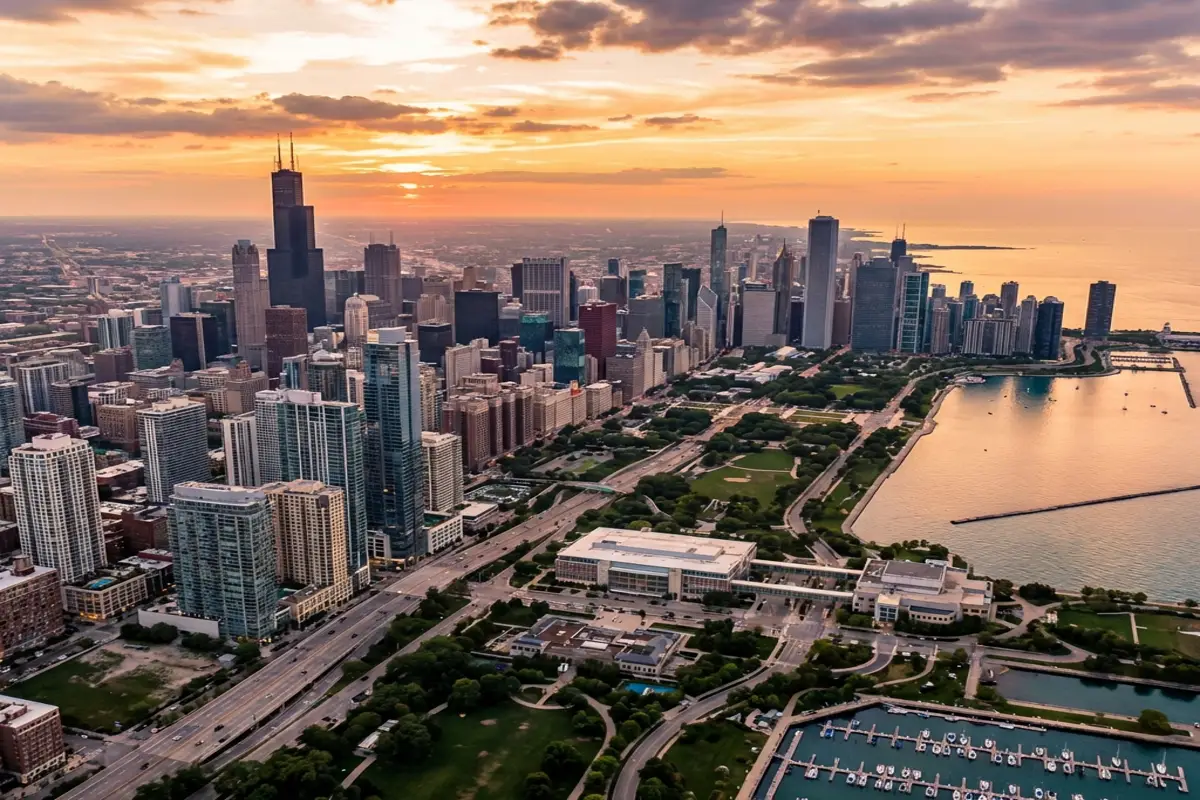
Open CPS School LocatorThe L remains one of Chicago’s main arteries, but the lakefront is an equally important force in neighborhood choice. The city’s roughly 18-mile Lakefront Trail, public beaches, parks, and shoreline access shape daily life from the South Side to the northern city limits. At the same time, rising housing costs and redevelopment continue to extend demand beyond long-established high-cost areas, including north toward Rogers Park and west across Western Avenue.
The dividing lines are not only price or commute time. Access to the water, dependable transit, parks, neighborhood businesses, housing type, and local identity all matter. Many high-demand areas combine several of those qualities with a manageable trip to downtown, but Chicago’s neighborhoods remain distinct in ways that do not show up in a rent listing alone.
How to read the numbers: Prices, commute times, walkability references, ratings, and fees in this guide are directional editorial ranges compiled for the 2026 guide. They are not live quotes, official measurements, or guarantees. Conditions can vary substantially by exact address, unit, route, time of day, school boundary, lease terms, building management, and individual block.
Chicago boundary note: Common neighborhood names, City of Chicago community areas, ward boundaries, ZIP codes, school attendance areas, and historic-district boundaries do not always match. Confirm the exact address with the relevant City, transit, school, and property records rather than relying on a listing’s neighborhood label.
| Neighborhood | Character | Directional 1BR Rent Position | Best For |
|---|---|---|---|
| West Loop | Converted warehouses, dining, and new development | $$$$ | Downtown and Fulton Market professionals |
| Logan Square | Boulevards, independent businesses, and varied housing | $$$ | Households seeking space and neighborhood activity |
| Pilsen | Mexican American cultural institutions, murals, and food | $$ | Residents drawn to culture, food, and central access |
| Rogers Park | Lakefront access, vintage buildings, and broad diversity | $$ | Residents prioritizing water access and relative value |
| Lincoln Park | Historic streetscapes, parks, and established amenities | $$$$ | Higher-budget households seeking park access and convenience |
| The Loop | Downtown transit, architecture, and cultural institutions | $$$ | Professionals prioritizing a minimal office commute |
The Character: Converted warehouses, dining, and new development
Rent Check: Directionally about 40% above the city average, with many one-bedrooms starting around $2,100+
Walkability and Commute Context: Walkability can feel close to the high 90s in the busiest sections because restaurants, offices, grocery options, gyms, transit, and entertainment cluster within a compact grid. For residents working in Fulton Market or the western Loop, some commutes can be completed on foot; CTA and Metra access also support broader downtown and regional trips.
The Good: West Loop remains one of Chicago’s leading concentrations of high-end dining, nightlife, and new development. Randolph Street’s Restaurant Row and the adjoining Fulton Market District form a major culinary corridor, while converted warehouses, loft buildings, corporate apartments, and newer towers have attracted workers in technology, finance, hospitality, professional services, and related fields.
The neighborhood offers useful open space at Mary Bartelme Park, along with convenient access to the Loop, Greektown, the Near West Side, and the river. Its appeal is less about a single landmark than everyday convenience: errands, dining, exercise, work, and entertainment can often be handled within a few blocks.
The Trade-Offs: Traffic on Lake Street and surrounding streets can be difficult during rush hour. The former industrial aesthetic is now largely polished concrete, preserved brick, and high-end new construction rather than working-district grit. Parking is limited, garages can carry substantial fees, and restaurant crowds may make evenings noisy. Construction, delivery traffic, late-night activity, and train noise vary considerably by block and building orientation.
Best For: Dual-income households and professionals working in the Loop, Fulton Market, or nearby employment centers. It is especially suitable for residents who prioritize dining, nightlife, and a short work trip enough to accept premium rent, parking, and daily costs.
Insider Tip: Skip the longest Randolph Street lines and explore side streets and older warehouse blocks before walking through Mary Bartelme Park at dusk. The dog park, skyline views, and open lawn provide a useful counterpoint to Fulton Market’s dense restaurant scene.
The Character: Boulevards, independent businesses, and varied housing
Rent Check: Directionally about 20% above the city average, around $1,800 for many one-bedrooms
Walkability and Commute Context: The Blue Line is a major connection to the Loop and O’Hare. Depending on the station, wait, and destination, a downtown train trip can be around 25 minutes, though door-to-door travel is often longer. Walkability is strongest near commercial corridors and stations; Logan Square is large enough that a stated “walkable” location should always be mapped from the actual address.
The Good: Logan Square offers many elements of city living with more residential breathing room than the densest lakefront neighborhoods. The Illinois Centennial Monument, boulevard system, independent restaurants, cocktail bars, coffee shops, music venues, and farmers market anchor an active local culture. Housing ranges from courtyard apartments and two-flats to larger greystones, renovated houses, and newer apartment buildings. Some properties still offer yards, porches, or shared outdoor space.
The southern and eastern portions of greater Logan Square also offer access to The 606, while Palmer Square and the boulevards provide additional places to walk, run, or sit outside.
The Trade-Offs: The neighborhood’s transformation is well advanced. Longstanding dive bars and lower-cost storefronts increasingly compete with natural-wine bars, upscale restaurants, and higher-rent businesses. Infrastructure can feel uneven, with potholes, alley issues, construction, and seasonal service frustrations. Reported property and vehicle-related incidents occur, but current conditions should be reviewed at the exact address and through official data rather than treated as uniform across Logan Square.
Best For: Families and other households that want more space, possible yard access, and a roughly 25-minute train ride under favorable conditions while remaining close to independent businesses and nightlife. School needs require address-specific research because Chicago Public Schools attendance boundaries, selective programs, admissions rules, and transportation options vary.
Insider Tip: The 606 Trail is a genuine daily-life asset for residents in the neighborhood’s southern reaches, but “within two blocks” should be verified on a map because Logan Square covers a large area. Try a locally owned deli or bakery, then take food to the trail or Palmer Square rather than driving between destinations.
The Character: Mexican American cultural life, murals, food, and active change
Rent Check: Directionally about 5% below the city average, around $1,425 for many one-bedrooms
Walkability and Commute Context: Commercial activity clusters around 18th Street, while transit convenience depends heavily on proximity to the 18th Street Pink Line station and bus routes. Travel time to downtown can vary notably by station access, waits, transfers, and final destination.
The Good: Pilsen retains a strong cultural identity despite intense development pressure. Murals along and near 16th Street are not merely visual backdrops; they reflect political movements, community history, immigration, labor, and Mexican American life. The food scene spans tamales, carnitas, mole, bakeries, cafés, taverns, and newer chef-driven restaurants. Thalia Hall hosts major acts, while the free National Museum of Mexican Art is an essential cultural institution.
Pilsen can remain relatively affordable compared with Chicago’s most expensive central neighborhoods, although the gap narrows in renovated buildings and near major commercial streets. Artists, musicians, service-industry workers, multigenerational households, and newer arrivals all contribute to the area’s daily character.
The Trade-Offs: Housing costs and displacement are active neighborhood concerns. Rapid development along 18th Street and near the 18th Street Pink Line has created serious tension with longtime residents. A high-priced new apartment may sit beside a home occupied by the same family for decades. Prospective residents should approach Pilsen as a living community with deep roots, not as an inexpensive arts district to be “discovered.”
Industrial land, rail infrastructure, festivals, nightlife, and busy streets can generate noise. Building condition, parking, transit access, and late-night activity differ significantly across the neighborhood.
Best For: Residents drawn to cultural institutions, food, music, and relatively central access who are prepared to engage respectfully with the community and its ongoing housing pressures. Those seeking a highly uniform, corporate-style residential environment may prefer another area.
Insider Tip: Explore beyond the busiest section of 18th Street. Visit the museum, spend time with the murals rather than treating them only as photo backgrounds, and support longstanding bakeries, markets, taquerias, and other locally rooted businesses. Some restaurants commonly associated with Chicago’s broader Mexican dining scene are outside Pilsen, so confirm addresses before building an itinerary.
The Character: Lakefront access, vintage buildings, and broad diversity
Rent Check: Directionally about 5% below the city average, around $1,425 for many one-bedrooms
Walkability and Commute Context: The Red Line operates around the clock, and Metra service is also available from the neighborhood. A favorable downtown rail trip may be around 30 minutes, but door-to-door travel can take longer once walking distance, waits, station access, transfers, and the final destination are included.
The Good: Rogers Park remains one of Chicago’s strongest lakefront value propositions. Residents have access to beaches and shoreline parks including Loyola Beach, Leone Beach, and smaller street-end lakefront spaces that can feel less compressed than the busiest beaches farther south. Housing includes vintage courtyard buildings, lakefront apartments, condos, and smaller multifamily properties.
Rents can be moderate for a neighborhood directly on Lake Michigan. Rogers Park is also one of Chicago’s most internationally diverse communities, reflected in independent restaurants and markets along Clark Street, Morse Avenue, Devon Avenue, and Touhy Avenue. The strongest food and retail corridors are spread across a large area rather than concentrated on a single strip.
The Trade-Offs: Rogers Park can feel distant from nightlife and employment corridors farther south and west. Blocks near the Howard Red Line station and other high-traffic areas may have more visible street-level challenges, including homelessness or public drug use. Conditions can change quickly by block and time of day, so personal visits and current official incident information are more useful than broad neighborhood labels.
The commute can feel long despite a relatively direct rail line, particularly for residents far from stations or with jobs outside the central business district. Lake exposure can also mean windier winter walks and more variable conditions near the shoreline.
Best For: Residents who prioritize water access, vintage housing, cultural diversity, and relative rental value. It can suit someone who wants to live near the beach for a cost that may be closer to a studio in Lakeview, while accepting a longer trip to central Chicago.
Insider Tip: Do not limit a search to the most obvious beach entrances. Walk the lakefront between Loyola and Touhy, compare smaller parks and street-end access points, and identify which Red Line, bus, or Metra option best fits the exact address. The historic New 400 Theater area and the Morse corridor are useful reference points, but current operating details should be checked before visiting.
The Character: Historic streetscapes, major park access, and established amenities
Rent Check: Directionally about 50% above the city average, with many one-bedrooms starting around $2,250+
Walkability and Commute Context: Walkability is high across many sections, with errands, parks, restaurants, and transit often close together. Transit access depends on the exact location relative to CTA rail stations and bus routes, while bike and walking access to the lakefront can be a major daily advantage.
The Good: Lincoln Park Zoo, the conservatory, North Pond, nearby lakefront paths, and extensive parkland are major free or low-cost amenities. Brownstone, greystone, and brick-lined streets around Clark Street, Armitage Avenue, Fullerton Avenue, and Sheffield Avenue include some of the city’s most attractive residential blocks.
The area contains public, private, and independent school options that many families investigate closely. However, quality, eligibility, admissions, transportation, and attendance boundaries differ by exact address and program. A Lincoln Park mailing address does not guarantee placement at a particular school. Many blocks feel orderly and residential, though conditions still vary and no urban neighborhood is incident-free.
The Trade-Offs: Housing can absorb a substantial share of a household budget. A two-flat or single-family property may require high income, while property taxes, maintenance, parking, association fees, and renovation costs add to total carrying cost. Nightlife often leans toward polished taverns, wine bars, sports bars, and relatively expensive restaurants. Some residents value the area’s consistency; others may find it less varied than neighborhoods farther west or south.
Noise, student activity, traffic, and weekend crowds can differ sharply near DePaul University, major commercial corridors, and popular entertainment areas. Verify the building’s immediate surroundings rather than assuming the entire neighborhood has the same rhythm.
Best For: Higher-budget families and professionals seeking classic Chicago streetscapes, extensive park access, and daily convenience. It is particularly attractive to households willing to pay for location while independently confirming school fit, building costs, and transit access.
Insider Tip: Do not judge the neighborhood solely from its busiest commercial streets on a Saturday. Its quieter character appears on side streets north and south of Armitage Avenue, though nearby DePaul activity and corridor traffic can change the experience. Compare daytime, evening, and weekend visits before deciding.
The Character: Downtown transit, architecture, and cultural institutions
Rent Check: Directionally about 25% above the city average, around $1,875 for many one-bedrooms
Walkability and Commute Context: The Loop is the nexus of nearly every CTA rail line and a dense bus network. Metra terminals are within or near the broader central business district. For many downtown workers, the work commute is difficult to beat; however, daily errands, grocery options, noise, and after-hours activity vary substantially between blocks.
The Good: Architectural interest is everywhere, from the Chicago Cultural Center and historic towers to the riverwalk, public art, and elevated-track streetscapes. After office crowds leave, parts of the district can feel quiet and visually dramatic.
Newer luxury residences and hotels, including the St. Regis Chicago development east of the traditional Loop in Lakeshore East, have expanded high-end service and dining around downtown. Cultural access is a major advantage: theaters, museums, Millennium Park, Grant Park, and the lakefront can function as everyday amenities rather than special trips.
The Trade-Offs: Some blocks become notably quiet on weekends and after 6 or 7 PM on weeknights, particularly away from theater, tourism, and residential pockets. The neighborhood feeling can be limited because office buildings dominate much of the district. Grocery shopping may be less convenient or more expensive than in a traditional residential neighborhood, and sirens, trains, deliveries, demonstrations, festivals, and construction can create recurring noise.
The Loop is increasingly residential, but it still often functions first as a center for work, institutions, tourism, and transportation. The experience differs substantially between the theater district, the Printer’s Row edge, Lakeshore East, riverfront blocks, and areas near major transit stations.
Best For: Professionals in finance, law, consulting, healthcare, government, and other downtown-based fields who place a premium on minimal commute friction. It can also suit residents who value architecture, cultural access, and a highly connected location over a conventional neighborhood rhythm.
Insider Tip: The Chicago Riverwalk around sunset, including the stretch near Tiny Tapp when seasonal operations are open, can provide a welcome break from downtown streets. Jay Pritzker Pavilion in Millennium Park also hosts free programming, giving nearby residents access to a major outdoor performance venue.
For Families: Start with Logan Square or Lincoln Park, but evaluate the specific address rather than the neighborhood name alone.
Logan Square generally offers more relative value and housing variety. Buyers may still encounter houses with yards below $1.2 million in the broader area, while the Blue Line can support a convenient downtown commute. Availability, condition, taxes, school boundaries, distance to transit, and renovation needs will determine whether that figure is realistic for a particular search.
Lincoln Park is the higher-budget option for households seeking established amenities, park access, and proximity to a range of public and private school options. It is not a no-compromise choice: admissions, assigned schools, housing costs, traffic, and block-level conditions still require independent research.
Rogers Park is a useful alternative for families that prioritize the lake, cultural diversity, and relative value over brand recognition or a short downtown commute. Confirm transit timing, school options, building condition, and winter walking distance before committing.
For Downtown, Finance, and Technology Workers: West Loop is the clearest choice for people employed in Fulton Market or the western Loop because home may be within walking distance of the office. For a somewhat longer commute and potentially around 20% rent savings, examine the northern edge of River West. Depending on the address, residents may still walk, bike, or use a short transit trip to Fulton Market while gaining access to older housing and a less uniformly new-construction environment. The potential savings are directional, not guaranteed.
The Loop fits professionals who place exceptionally low commute friction above a traditional residential atmosphere. Compare grocery access, building fees, street noise, and evening activity before choosing between the Loop, West Loop, Lakeshore East, and adjacent central neighborhoods.
The Value Play: Pilsen and Rogers Park remain the leading relative-value choices on this shortlist, but neither should be presented as a guaranteed investment or appreciation opportunity.
Pilsen offers cultural depth, strong food and arts institutions, and relatively central access, while also facing displacement pressure and higher rents in renovated properties. Its identity belongs to the community, not speculative branding.
Rogers Park offers practical lakefront access at rents that can remain below those of better-known North Side neighborhoods. A condo or rental may provide more space or closer beach access for the money, but future prices, appreciation, assessments, taxes, insurance, and monthly costs cannot be predicted. Treat the approximate $1,400–$1,425 monthly figure as a directional snapshot, not a promise that every suitable unit will be available at that price.
Neighborhood names are only a starting point. For every finalist:
Neighborhood names are useful orientation, but official boundaries and service areas can differ. Before signing, verify the exact address against official boundary and planning maps, current reported incident information, transit routes and service levels, and school assignment. Ask for a written comparison of rent or purchase price, parking, fees, taxes, utilities, property condition, commute assumptions, and included amenities so competing addresses can be evaluated on the same terms.
Citywide reference fields are not current quotes for a neighborhood or property.
Neighborhood Decisions
Late-night culture, 24-hour joints, and affordable rent for people who come alive after dark
City analysisTen original city records compared without an invented transit score or unsupported service claims.
City analysisDitch the car payment, insurance, and gas — these walkable cities make it easy