Verify the exact home
Check the current listing, lease terms, deposits, utilities, insurance and recurring fees. A citywide median is not a property quote.
From central districts to quieter residential areas, use this guide to build a Pomona shortlist, then verify the exact address and current conditions.
Address-level verification workflow
The editorial guide below can help build a shortlist, but rents, home values, safety, schools and travel times can differ by block and change quickly. Complete these checks before signing or buying.
Check the current listing, lease terms, deposits, utilities, insurance and recurring fees. A citywide median is not a property quote.
Use the local police or open-data portal for the exact address and relevant time period. Citywide rates cannot prove block-level risk.
District and attendance boundaries can change. Verify the exact address with the district before relying on a school assignment.
Travel the route at the hours you would use it and include parking, transfers, tolls and weather—not only an off-peak estimate.
Combine housing, transportation, taxes, insurance, childcare and debt. Neighborhood fit depends on the household, not a universal winner.
Walk the area during daytime and evening, check noise and services, and speak with qualified local professionals where appropriate.
Reviewed local sources
These links are owned by local government, public safety, transit or school organizations. Use the exact address and current date range. An incident map is not a prediction, a nearby school is not proof of assignment, and a route map is not a commute guarantee.
The guide’s prices, ranges, walkability, school context and commute estimates are directional editorial snapshots, not live quotes. Markets and services change; verify the current property, route and assignment before deciding.
Source registry reviewed 2026-07-19.
U.S. Census Bureau
Locate the exact street address or coordinates and inspect the current Incorporated Places layer for Pomona. Do not treat a Pomona mailing address, ZIP code, census-designated place reference, or Los Angeles County location alone as proof that a parcel is inside the incorporated City of Pomona.
Open TIGERweb Incorporated Places MapCalifornia Department of Justice
Use the state crime-statistics resources to select Pomona Police Department data and the applicable reporting year. Confirm that any address or event falls within the reporting agency's jurisdiction; statewide reported-crime data are not a live call-for-service or incident-log feed.
Open California Crime StatisticsFoothill Transit
Check the exact address against current nearby stops, routes, schedules, and service notices. Being within Pomona city limits or having a Pomona mailing address does not guarantee Foothill Transit coverage, and Metro or Metrolink service has separate routes and eligibility.
Open Foothill TransitPomona Unified School District
Verify the exact residence address through the district's enrollment or attendance-boundary process rather than relying on a Pomona postal address. Some Pomona-address locations may be assigned to another district, and program, grade, and enrollment eligibility can affect school assignment.
Open Pomona Unified School DistrictDirectional 2026 editorial snapshot: Pomona’s rent and price descriptors below are relative observations for 2026—not live listing data, guaranteed availability, or a promise of future value. Neighborhood labels are useful local shorthand, but they are not always official parcel-level boundaries.
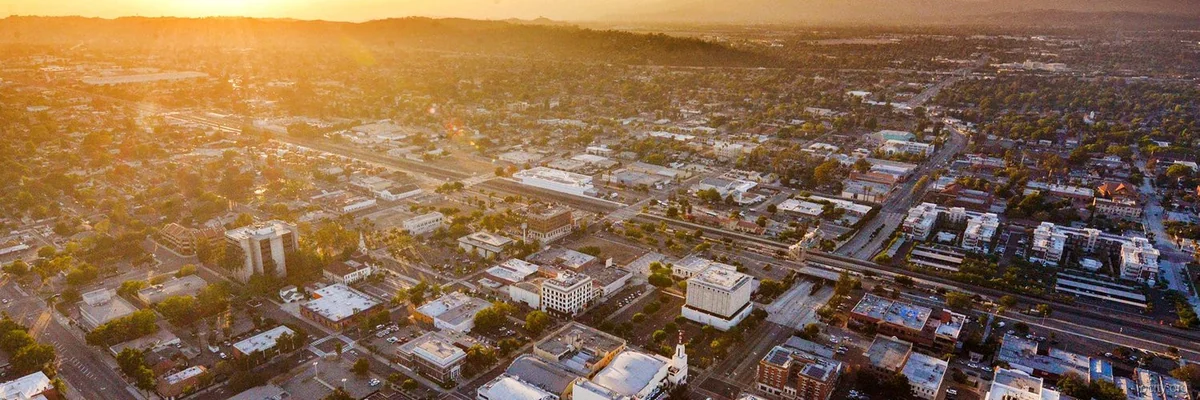
Pomona sits in eastern Los Angeles County, at the western edge of the Inland Valley, with major anchors including the Fairplex—the home of the Los Angeles County Fair—and Cal Poly Pomona. Its housing, streetscape, and daily rhythm vary substantially by block: historic residential streets near Garey Avenue and Towne Avenue, the Downtown Arts Colony’s event-oriented core, hillside pockets, and lower-density subdivisions each offer a different trade-off.
Downtown Pomona has continued to build around music, art, restaurants, and events, while areas such as Phillips Ranch remain more residential and car-oriented. That change is not cleanly divided by White Avenue: Phillips Ranch is generally southwest of Downtown, and neighborhood transitions do not follow one simple east-west line.
Transit deserves a careful correction. Pomona has regional rail and bus options, including Downtown Pomona and Pomona–North Metrolink stations, but the Metro A Line—formerly called the Gold Line—does not currently serve Pomona. Any future Foothill extension should be treated as a project-status question, not as a finished station, commute guarantee, or reason to assume nearby renovations.
| Neighborhood | Vibe | Price Score (1BR) | Best For |
|---|---|---|---|
| Downtown / Arts Colony | Creative, industrial, event-oriented | High | Artists, musicians, nightlife-oriented renters |
| Phillips Ranch | Low-density suburban | High | Families, space seekers, quiet-focused households |
| Ganesha Hills | Established hillside residential | Medium | Cal Poly staff, graduate students, hillside-home seekers |
| North Pomona | Mixed residential and value-oriented | Low | Renovation-ready buyers, value-focused renters |
How to read the table: “High,” “Medium,” and “Low” are directional 2026 editorial comparisons for one-bedroom rents within this shortlist. They are not live quotes, listing inventories, or guarantees that a specific unit will rent at a given level.
Downtown / Arts Colony is among Pomona’s most compact, walkable districts. The Glass House and Fox Theater remain important cultural anchors, and the surrounding blocks can make it practical to walk between concerts, galleries, restaurants, bars, and late-night food when venues are active.
The Pomona Arts Colony’s loft and adaptive-reuse aesthetic—older commercial buildings, high ceilings, and brick-forward interiors where available—can appeal to renters seeking a more urban setting than most of Pomona offers. Downtown also provides access to the Downtown Pomona Metrolink station, though the actual usefulness of that rail option depends on the current schedule, destination, and return-trip timing.
Activity can drop considerably outside event nights, and the experience changes from block to block. Event parking, street closures, noise, and rideshare congestion are practical concerns near major venues.
Do not treat reports of vehicle break-ins, broken glass, or nighttime discomfort as universal conditions. Review recent official reported-incident data for the specific block, visit at the hours you expect to be out, and assess lighting, parking access, and building security yourself.
Downtown is more walkable than most of Pomona, but it is not the city’s only place where errands can be completed on foot. Its advantage is concentrated venue access rather than all-purpose daily retail convenience.
The alleyways off Garey Avenue between Mission Boulevard and Orange Grove Avenue can be worth exploring for public-facing street art, provided access is legal and comfortable at the time of visit.
The durable local draw is the concentration of music and arts venues—not a fixed list of bars or restaurants. Confirm the current address, hours, and operating status of any business before choosing an apartment around it. Likewise, do not assume a loft is rent-controlled because of its location or building type; confirm the unit’s legal status, lease terms, and applicable local protections in writing.
Phillips Ranch is a common first comparison point for buyers and renters who want winding residential streets, lower-density development, and a quieter setting than Downtown. Some addresses have hillside or mountain-facing views, though views depend on the individual lot, elevation, neighboring construction, and weather.
The neighborhood’s residential character is the main appeal: homes, cul-de-sacs, and a more removed feel from Downtown’s nightlife and event traffic. It can suit households that value space and a calmer evening environment.
Phillips Ranch Elementary is frequently cited by local home shoppers as part of the area’s appeal. That interest should be treated as a prompt for direct school research, not as a blanket quality claim.
Most errands are car-dependent. Sidewalk coverage, walkability, and access to groceries or restaurants vary by subdivision, but the overall pattern favors driving rather than quick trips on foot.
Depending on the exact address, regional road access may involve SR-71, SR-60, and I-10. It is not a rail-adjacent neighborhood, and residents should not assume easy access to a Metro rail line.
Some subdivisions may have homeowners’ associations, dues, architectural rules, or maintenance obligations. Confirm all association documents, fees, insurance requirements, and parking restrictions before making an offer or signing a lease.
School ratings, parent reviews, and district comparisons are not substitutes for an address-specific assignment check. Confirm the assigned elementary, middle, and high schools directly with the relevant district, then separately evaluate programs, transportation, enrollment conditions, and fit for the student.
A trail or open-space outing near Phillips Ranch Road and the Sunset Oaks area may appeal to residents seeking a nearby weekend walk. Do not assume that an apparent trail entrance is public or accessible: verify the exact trailhead, parking rules, operating hours, and posted access conditions through the appropriate city or land-management source.
Ganesha Hills offers an older, more established residential setting with slopes, mature landscaping, and a visual character that can feel greener and more shaded than flatter parts of the city. Housing stock varies, but older homes may offer more architectural variety than newer tract areas.
It can work for Cal Poly Pomona employees, graduate students, or campus-connected households who prefer a separate residential environment rather than living directly beside campus.
Ganesha Hills is not immediately adjacent to Cal Poly Pomona, and most addresses are not practical walking distance from the Bronco Student Center or W. K. Kellogg Arabian Horse Center and related campus amenities. Plan for driving, biking, or transit connections rather than a walk-to-campus routine.
The prior assumption that college-party noise or finals-week parking affects all of Ganesha Hills is too broad. Street conditions depend on the particular block, nearby schools or parks, freeway exposure, driveway supply, and local parking rules. Visit during weekday evenings and weekends before deciding.
Older housing can require more attention to electrical systems, roofs, drainage, retaining walls, HVAC, insulation, and hillside maintenance. A thorough inspection matters more than the neighborhood label.
Temple Avenue is closer to Cal Poly Pomona than Ganesha Hills itself. Any recommendation for a specific coffee shop or gathering place along Temple Avenue should be verified for current location and operating hours before treating it as a neighborhood amenity.
“North Pomona” is a broad local label rather than one uniform neighborhood. It generally refers to areas north of I-10, with some addresses nearer La Verne, San Dimas, or Claremont-facing corridors. The area can offer older housing, varied lot sizes, and lower relative entry costs than some other parts of the shortlist.
For road commuters, many North Pomona addresses offer useful access toward I-10 and SR-57. Pomona–North Metrolink may also be relevant for some addresses, but the walk, parking, schedule, and destination must be checked individually.
Housing style, lot size, and condition vary sharply. Do not assume that every block has an unrenovated Craftsman, a large lot, or a lower purchase cost. Confirm building age, permits, lot dimensions, zoning, utility condition, and any renovation history through public records and inspections.
Some edges of North Pomona sit closer to freeway, commercial, warehouse, or industrial activity. That can mean more traffic, truck activity, road noise, or air-quality concerns for certain properties—not the entire area.
Do not rely on broad statements that reported crime is higher here than in Phillips Ranch. Compare recent official reported incidents for the exact streets and a consistent time period, while remembering that reports and calls for service do not measure every safety condition or predict an individual experience.
There is no direct I-10/I-210 interchange in Pomona. I-10 connects with SR-57 in Pomona, while I-210 is reached farther northwest through the SR-57/San Dimas area. Travel times depend heavily on the destination and peak-period traffic.
The well-known original Donut Man location is in Glendora, not on Garey Avenue in Pomona. It may be a regional breakfast drive for some residents, but it should not be treated as a North Pomona walkable amenity.
The previously cited San Antonio Avenue and Foothill Boulevard area should not be used as a North Pomona locator or as a basis for a speculative purchase decision. Confirm city jurisdiction, neighborhood boundaries, and the exact address before comparing any property near that corridor.
Neighborhood shorthand is useful for narrowing a search, but an address should be verified before any lease, offer, or commute decision.
Use the City of Pomona’s planning or mapping resources and Los Angeles County parcel records to verify:
Use official Pomona Police Department reporting or mapping resources to review recent reported incidents around each exact address. Compare the same time period, geographic area, and incident categories for every property under consideration.
Also check:
Reported incidents and calls for service are useful context, not a guarantee of safety or a complete measure of neighborhood conditions.
For each address, verify the closest practical rail station, bus stop, parking option, walking route, fare, service calendar, and final return trip.
Run the drive at your actual commute time when possible. A route that works on a Sunday afternoon may be materially different during weekday peak traffic.
Confirm school assignment directly with the district responsible for the exact address. Ask for a written response covering:
Do not rely solely on a real-estate listing, neighborhood reputation, or third-party school-rating site. Attendance boundaries and available programs can change.
Before choosing between properties, make a dated written comparison using the same criteria for each address.
| Comparison Item | Address A | Address B | Address C |
|---|---|---|---|
| Official jurisdiction and neighborhood label | |||
| Parcel, zoning, legal-unit, and permit review | |||
| HOA, dues, parking, and rental restrictions | |||
| Recent reported-incident review using the same period and area | |||
| Weekday morning and evening noise/traffic visit | |||
| Nearest practical rail, bus, and driving commute options | |||
| School district’s written assignment response | |||
| Rent or ownership costs, utilities, repairs, and insurance | |||
| Best trade-off for your household |
Start with Phillips Ranch if your priorities are a lower-density setting, quieter residential streets, and suburban housing patterns. Treat its school reputation as a research lead rather than a guarantee: confirm the exact assignment, program availability, commute burden, HOA obligations, and sidewalk or park access.
Use Ganesha Hills as a secondary comparison if you prefer established homes, trees, and a hillier setting, but inspect property condition and determine whether the daily driving pattern works for your household.
There is no universal commuter winner.
Choose Downtown / Arts Colony when being near the Glass House, Fox Theater, galleries, and event activity outweighs parking pressure, variable late-night street conditions, and higher relative rents. Visit both a quiet weeknight and an event night before committing.
Choose Ganesha Hills only if you are comfortable commuting to campus rather than walking there. It can offer a distinct residential setting for faculty, staff, and graduate students, but it is not a campus-adjacent district. Compare it with addresses closer to Cal Poly Pomona based on your actual class, work, and parking schedule.
Start with North Pomona if lower relative rent or older housing stock is more important than polished streetscape, uniform amenities, or turnkey condition. This is a practical value comparison—not an immediate-purchase or speculative investment recommendation. Base the decision on inspection results, legal permits, freeway and industrial exposure, commute testing, and a written comparison with at least one alternative address.
Citywide reference fields are not current quotes for a neighborhood or property.
Neighborhood Decisions
The 21st Century ROAD Act could reshape the rental market. But will it actually lower rents?
housingSolo living is a luxury in most metros. Here's exactly what you need to earn in 50 cities.
housingThe 30% rule is dead. Here's what financial planners actually recommend in 2026 — by city.