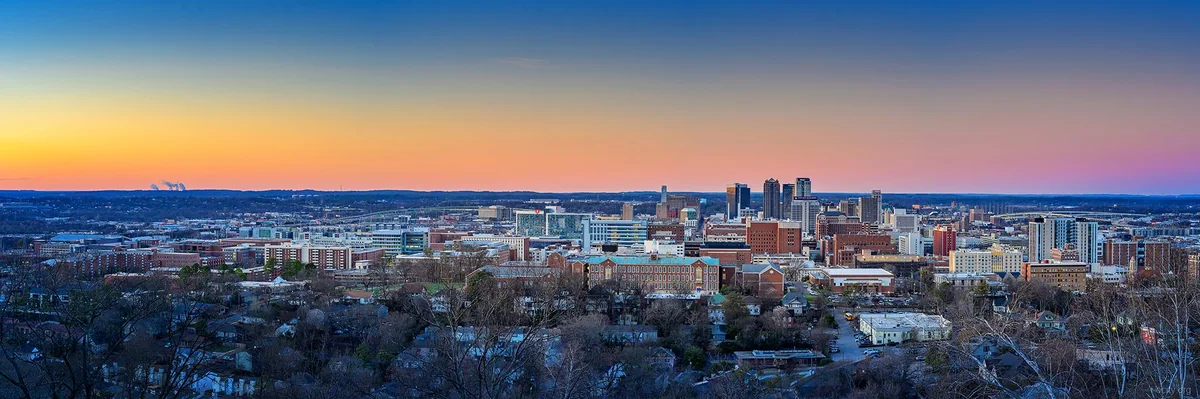
196,518
Population
$44,951
Median Income
$227K
Median Home Price
31%
Bachelor's Degree+
Purchasing Power Analysis
Lifestyle Impact in Birmingham
Birmingham is 7.4% cheaper than the national average. We calculate how much your salary "feels like" here.
Real Purchasing Power
$91,793
+8%
Extra lifestyle value
Relative to US Average
COL Adjusted
Real-time Metrics
Offer decision workflow
Got a job offer for Birmingham?
Birmingham can stretch a paycheck further than many major markets, so a smaller headline offer may still work if your monthly leftovers improve.
Decode an offer in Birmingham
Check how salary, bonus, taxes, and Birmingham living costs change your real leftover cash.
Set your counteroffer
Use a negotiation-first playbook to choose between more base pay, a sign-on bridge, or a walk-away number.
Calculate walk-away pay
Turn Birmingham's cost structure into a city-specific salary target before you accept or push back.
Follow the relocation workflow
Use the full workflow if the decision includes relocation costs, deposits, and a city-to-city move.
1. Birmingham: The Data Profile (2026)
Birmingham presents a complex economic case for 2026. The city supports a population of 196,518, classifying it as a manageable mid-sized urban center. The primary statistical friction point is income potential; the Median Household Income stands at $44,951, which is -39.7% lower than the US average of $74,580. However, this income deficit is partially offset by a significantly lower educational barrier to entry, with only 30.8% of the population holding a bachelor's degree or higher (compared to the US average of 33.1%).
Target Demographic: The data suggests Birmingham is statistically optimized for:
- Remote Workers: Individuals earning national-average salaries who can leverage the -21.5% housing discount.
- Service & Trade Industries: Where the lower median income aligns with local cost structures.
- Healthcare Professionals: Given the region's specific health risk factors.
2. Cost of Living Analysis
The "Birmingham Discount" is most visible in the aggregate cost of living index. With a composite index of roughly 85-90 (depending on weighting), the city offers substantial relief compared to the national baseline.
TABLE 1: Monthly Budget Breakdown (Est. 2026)
| Category | Single Professional (Monthly) | Family of Four (Monthly) |
|---|---|---|
| Housing (Rent) | $1,266 (1BR) | $1,650 (3BR Est.) |
| Groceries | $285 | $950 |
| Transportation | $320 | $750 |
| Healthcare | $180 | $600 |
| Utilities (Electric) | $135 (900 kWh) | $240 (1,600 kWh) |
| Total Expenditures | ~$2,186 | ~$4,190 |
Disposable Income Analysis:
With a median income of $44,951, a single earner takes home approximately $2,850/month after taxes. Comparing this to the $2,186 required monthly budget, the theoretical disposable income is $664/month. While positive, this margin is tight compared to high-income metros. The value proposition relies entirely on dual-income households or remote work salaries.
💰 Cost of Living vs US Average
Birmingham's prices compared to national average (100 = US Average)
Cheaper than US
More expensive
Source: BLS & BEA RPP (2025 Est.)
3. Housing Market Deep Dive
The housing market is the city's strongest asset. The Housing Index sits at 78.5, indicating costs are -21.5% below the national average. This differential allows for significantly higher square footage per dollar.
TABLE 2: Housing Market Data (Buying vs Renting)
| Metric | Birmingham Value | US Average | Difference (%) |
|---|---|---|---|
| Median Home Price | $185,000 | $416,000 | -55.5% |
| Price / SqFt | $118 | $220 | -46.4% |
| Rent (1BR) | $1,050 | $1,550 | -32.3% |
| Rent (3BR) | $1,650 | $2,400 | -31.3% |
| Housing Index | 78.5 | 100 | -21.5% |
Buy vs. Rent Analysis:
The Price-to-Rent ratio is highly favorable for buying. With a median home price of $185,000 and annual rent equivalent for a 1BR at $12,600, the ratio is roughly 14.7. Generally, a ratio below 15 strongly favors buying. For 2026, purchasing property in Birmingham is statistically the superior financial move, locking in the -21.5% cost advantage long-term.
🏠 Real Estate Market
$227K
Median Home Price
-60.7% vs US avg
$102
Per Sq Ft
70
Days on Market
Source: Redfin 2025 estimates
4. Economic & Job Market Outlook
Birmingham's economic stability is currently robust, though income growth is stagnant. The Unemployment Rate is 2.7%, significantly lower than the US average of 4.0%. This indicates a tight labor market where jobs are available, but the quality of wages remains the constraint.
RTO & Commute:
In a post-remote 2026 landscape, Birmingham's infrastructure is a mixed bag. While traffic is lighter than major metros, the city lacks a comprehensive rail system. The average commute time hovers around 24 minutes, slightly below the national average. For hybrid workers, the lack of congestion is a major plus. For fully on-site workers, the reliance on personal vehicles (due to a 90.2 transportation index) is a mandatory cost.
Salary Wars
See how far your salary goes here vs other cities.
$75,000
US National Average
$75,000
Nominal Value
Real Value in Birmingham
$80,994
+8.0% Purchasing Power
Purchasing Power Leaderboard
#1
BirminghamYou
$80,994
#2
Houston
$74,850
#3
Chicago
$73,099
#4
Phoenix
$71,090
#5
New York
$66,667
💰 Income Comparison
5. Quality of Life Audit
Birmingham offers a "Good" aggregate Health Score of 75.1/100, but this masks significant underlying risk factors. The region struggles with chronic health issues, specifically obesity and diabetes, which are well above national averages.
TABLE 3: Quality of Life Metrics
| Metric | City Value | US Average | Rating |
|---|---|---|---|
| Health Score | 75.1 / 100 | N/A | Good |
| Obesity Rate | 42.2% | 31.9% | High |
| Diabetes Rate | 19.2% | 10.9% | High |
| Smoking Rate | 16.6% | 14.0% | Average |
| Unemployment Rate | 2.7% | 4.0% | Low (Excellent) |
| AQI (Air Quality) | 57 | 54 | Moderate |
Safety & Environment:
- Crime: Violent crime stands at 454 per 100k (US avg: 380), and Property crime is 2,345 per 100k (US avg: 2,000). Both rate as Average, meaning Birmingham is neither exceptionally safe nor dangerous relative to other US cities of its size.
- Air Quality: The AQI of 57 is categorized as "Moderate." The PM2.5 levels are slightly elevated but generally breathable for most. Sensitive groups should monitor air quality during summer months.
- Schools & Weather: The weather today is 64.0°F with showers, typical for a humid subtropical climate. While the verified data does not provide specific school ratings, the lower percentage of college-educated residents (30.8%) often correlates with lower funding or performance metrics in public systems compared to high-education hubs.
Quality of Life Metrics
Air Quality
EPA Annual Average
Good
42AQI
Air quality is satisfactory.
PM2.5 Concentration10.2 µg/m³
Health Pulse
CDC PLACES Data
75.1
Score
Obesity
42.2% Low Avg (32%) High
Diabetes
19.2% Smoking
16.6%
Based on CDC PLACES health census data. Higher score indicates better overall public health outcomes.
See healthiest US cities →
Safety Score
FBI Crime Data Estimate
Below Avg
Violent Crime
per 100k people
1234.0
US Avg: 363.8
Property Crime
per 100k people
4567
US Avg: 1917
Crime rates are generally higher than the national average.
See safest US cities →
6. The Verdict
Pros:
- Housing Value: The -55.5% discount on median home prices vs. the US average is the primary driver.
- Employment Security: A 2.7% unemployment rate indicates a stable, hungry job market.
- Low Overhead: Groceries (90.1), Transport (90.2), and Electricity (15.18 cents/kWh) are consistently below average.
Cons:
- Income Ceiling: Median income is -39.7% below the US average. Wealth accumulation is difficult without remote work.
- Health Risks: The environment promotes sedentary lifestyles, evidenced by a 42.2% obesity rate and 19.2% diabetes rate.
- Crime: While "Average," the violent crime rate of 454/100k is still elevated relative to safer metros.
Recommendation:
Birmingham is a Buy for 2026, specifically for remote workers or dual-income households. The low housing index allows for rapid equity building. It is not recommended for single-income earners seeking national-average salaries, as the wage deficit eats up the cost-of-living savings.
7. FAQs
1. What salary is needed to live comfortably in Birmingham?
For a single person, a salary of $60,000 provides a comfortable buffer over the median income. This breaks down to roughly $5,000/month gross, allowing for savings after the estimated $2,186 monthly expenses.
2. How does the value compare to other Southern cities?
Birmingham offers deeper housing discounts than Nashville or Atlanta. While Nashville's median home price exceeds $500,000, Birmingham remains under $190,000, offering a -60%+ advantage in shelter costs.
3. Is the crime rate actually dangerous?
Statistically, it is Average. The Violent Crime rate of 454/100k is higher than the safest suburbs but lower than the most dangerous major cities. Property crime is the more likely issue, occurring at a rate of 2,345/100k.
4. When is the best time to relocate?
Ideally, move between October and December. The weather (currently 64°F with storms) stabilizes, humidity drops, and the rental market typically softens before the winter holidays.
Explore More in AL
Popular Comparisons
City Resources
Compare Birmingham
Loading city calculator…