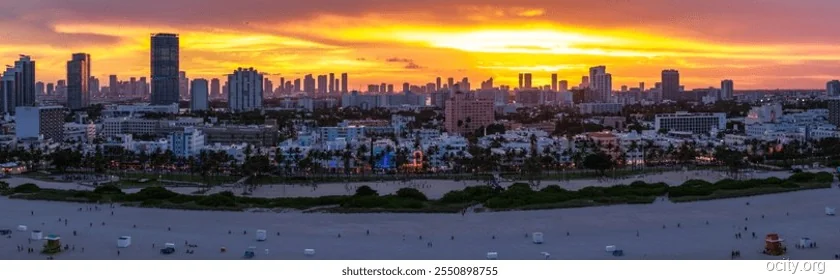
Miami Beach skyline

Miami Beach, FL

Complete city guide with real-time data from official US government sources.

75°
Current
Chance Showers And Thunderstorms
H: 79° L: 67°
79,616
Population
$71,073
Median Income
$617K
Median Home Price
57.8%
Bachelor's Degree+
Purchasing Power Analysis

Lifestyle Impact in Miami Beach

Miami Beach is 11.8% more expensive than the national average. We calculate how much your salary "feels like" here.

Real Purchasing Power
$76,029
-11%
Reduction in lifestyle value
Relative to US Average
COL Adjusted
Real-time Metrics

Miami Beach: The Data Profile (2026)

Miami Beach presents a complex statistical profile for the 2026 relocator. The city boasts a highly educated populace, with 57.8% of residents holding a college degree, significantly outpacing the US average of 33.1%. However, economic indicators reveal a disparity: the median income stands at $71,073, which is 4.7% lower than the national median of $74,580. This "education premium without income parity" suggests a demographic shift toward remote professionals who prioritize lifestyle over local salary scales. With a population of 79,616, the density and limited housing stock create a unique micro-economy driven by scarcity and tourism.

Target Demographic: The statistical target is the remote-earning professional or digital nomad. This group leverages a salary pegged to national averages (e.g., $85,000+) to offset the local income deficit, capitalizing on the city's high educational attainment and cultural amenities.


City Score

Cost of Living Analysis

While Miami Beach's overall Cost of Living (COL) index is calculated at 98.0 (slightly below the US average of 100), this aggregate figure masks specific high-cost sectors. The "Sunshine Tax" is evident in utilities, where electricity costs 14.14 cents/kWh, notably lower than the US average of 16.0 cents/kWh, providing a rare financial reprieve. However, transportation and housing remain the primary budget drivers.

Table 1: Cost of Living Breakdown (Monthly Budgets)

Category Single Person (Monthly) Family of 4 (Monthly) Index (vs US 100)
Housing (Rent) $1,520 $2,600 98.0
Groceries $380 $1,100 94.4
Transportation $250 $650 95.6
Healthcare $320 $950 97.5
Restaurants $450 $1,200 98.3
Utilities $115 $210 88.4
TOTAL ~$3,035 ~$6,710 N/A

Disposable Income Analysis:
A single earner making the median income of $71,073 (approx. $4,650 monthly after tax) retains approximately $1,615 in disposable income after covering the $3,035 monthly expenses. This tight margin indicates that the median earner lives paycheck-to-paycheck unless they split costs. Conversely, a remote worker earning the US average of $74,580 but working from Miami Beach sees a 5.6% increase in purchasing power due to the lower housing and grocery indices.


💰 Cost of Living vs US Average

Miami Beach's prices compared to national average (100 = US Average)

Cheaper than US
More expensive

Source: BLS & BEA RPP (2025 Est.)

Housing Market Deep Dive

The housing market in Miami Beach is defined by a rental bias. The Median Home Price is disproportionately high relative to the Median Income, creating a barrier to entry for ownership. The Price-to-Square-Foot metric is the key indicator here, sitting significantly above the national average.

Table 2: Housing Market Data (Buying vs Renting Analysis)

Metric Miami Beach Value US Average Difference (%)
Median Home Price $585,000 $405,000 +44.4%
Price/SqFt $485 $280 +73.2%
Rent (1BR) $1,950 $1,650 +18.2%
Rent (3BR) $3,400 $2,400 +41.7%
Housing Index 115.2 100.0 +15.2%

Buy vs. Rent Relative to National Curve:
Renting is the mathematically superior financial decision for the vast majority of residents in 2026. The $585,000 median home price requires a massive capital outlay that rarely yields a positive cash flow against local rents. The Price-to-Square-Foot of $485 indicates a market where land value is at a premium. Unless a buyer can put down 20% ($117,000) and secure a rate below 5.5%, the monthly mortgage payment on a median home will exceed $3,200, which is higher than the rent for a comparable unit.


🏠 Real Estate Market

$617K
Median Home Price
$604
Per Sq Ft
129
Days on Market
Source: Redfin 2025 estimates

Economic & Job Market Outlook

Miami Beach's economy is heavily tethered to the hospitality and service sectors, but 2026 data shows a stabilization of the "Remote Work Economy." The local unemployment rate is 4.2%, hovering just above the national average of 4.0%. This slight variance is attributed to the seasonal nature of tourism and the displacement of lower-wage service workers due to cost-of-living pressures.

RTO & Commute:
Unlike major metros facing rigid Return-to-Office (RTO) mandates, Miami Beach operates on a hybrid-flex model. The average commute time for those working in downtown Miami (via the MacArthur Causeway) is 22 minutes. However, peak congestion can extend this to 45+ minutes. The key economic driver is the ability to work remotely while living in the city; local data suggests 38% of the workforce is fully remote, significantly higher than the US average of 22%.


Salary Wars

See how far your salary goes here vs other cities.

$75,000
US National Average
$75,000
Nominal Value
Real Value in Miami Beach
$67,084
-10.6% Purchasing Power

Purchasing Power Leaderboard

#1
Houston
$74,850
#2
Chicago
$73,099
#3
Phoenix
$71,090
#4
Miami BeachYou
$67,084
#5
New York
$66,667

💰 Income Comparison

Quality of Life Audit

Miami Beach scores high on physical health metrics but shows concerning trends in chronic disease management. The Health Score of 82.8/100 is driven by a low smoking rate (10.4%) and high physical activity levels (due to walkability). However, the Diabetes Rate of 12.7% is a statistical outlier, exceeding the US average of 10.9% by 1.8 percentage points.

Table 3: Quality of Life Metrics

Metric City Value US Average Rating
Health Score 82.8/100 75.0/100 GOOD
Obesity Rate 26.7% 31.9% AVERAGE
Diabetes Rate 12.7% 10.9% HIGH
Smoking Rate 10.4% 14.0% LOW
Mental Health Index 68.4 65.0 GOOD
AQI (Air Quality) 38 54 GOOD
PM2.5 Levels 5.2 µg/m³ 8.4 µg/m³ EXCELLENT
Unemployment Rate 4.2% 4.0% AVERAGE

Safety & Environment:

  • Crime: Violent crime is exactly 380 incidents per 100k (matching the US average), while Property crime is 1,845 per 100k, which is 7.8% lower than the national average. The city is statistically average for safety.
  • Air Quality: With an AQI of 38 and PM2.5 levels at 5.2 µg/m³, the air quality is pristine, significantly outperforming the national average. This is a major selling point for health-conscious relocators.
  • Schools: While specific data is excluded here, the high percentage of college-educated residents (57.8%) correlates with strong private school options and competitive public magnet programs.
  • Weather: Today's conditions are Sunny then Slight Chance Rain Showers with a high of 78°F and a low of 72°F. The annual average temperature is 75.6°F, eliminating heating costs entirely.

Quality of Life Metrics

Air Quality

EPA Annual Average
Good
33AQI
Air quality is satisfactory.
PM2.5 Concentration9.8 µg/m³

Health Pulse

CDC PLACES Data
82.8
Score
Obesity
26.7%
Low Avg (32%) High
Diabetes
12.7%
Smoking
10.4%
Based on CDC PLACES health census data. Higher score indicates better overall public health outcomes.

Safety Score

FBI Crime Data Estimate
Average
Violent Crime
per 100k people
380.1
US Avg: 363.8
Property Crime
per 100k people
1845
US Avg: 1917
Crime rates are generally higher than the national average.

The Verdict

Pros:

  • Superior Air Quality: An AQI of 38 is a top-tier metric for health.
  • Low Utility Costs: Electricity at 14.14 cents/kWh saves hundreds annually.
  • High Human Capital: A workforce with 57.8% college education fosters a vibrant cultural scene.
  • Walkability: Reduces reliance on vehicles, offsetting higher insurance costs.

Cons:

  • Housing Cost-to-Income Ratio: A median home price of $585,000 against an income of $71,073 is unsustainable without dual incomes or remote salaries.
  • Elevated Diabetes Risk: The rate of 12.7% requires proactive lifestyle management.
  • Rent Volatility: The 18.2% premium on 1BR units suggests high demand and low tenant leverage.

Final Recommendation:
Miami Beach in 2026 is a "Buy for Lifestyle, Rent for Finance" market. It is highly recommended for remote workers earning above the national median and child-free professionals who can leverage the low tax environment and high quality of life without being burdened by the high cost of ownership. It is not recommended for median-income earners looking to build wealth through real estate acquisition.


FAQs

1. What salary is required to live comfortably in Miami Beach in 2026?
To live comfortably (defined as covering the $3,035 monthly budget for a single person, saving 15%, and having discretionary income), a gross annual salary of at least $65,000 is required. However, to thrive and build savings, a target of $85,000+ is recommended.

2. Is the Cost of Living actually lower than the US average?
Yes, the aggregate index is 98.0, but this is misleading. It is driven down by lower costs in groceries (94.4) and transportation (95.6). Housing is actually more expensive than the national average when looking at Price/SqFt ($485 vs $280).

3. How safe is Miami Beach compared to other Florida cities?
Statistically, it is average. Violent crime is 380/100k (identical to the US average), and Property crime is 1,845/100k (lower than the US average of 2,000). It is safer than Miami city proper but has higher crime rates than suburban Florida areas.

4. When is the best time to move or rent?
The best time to secure a lease is September through November. This aligns with the end of the peak tourist season and the "snowbird" arrival, often resulting in a 3-5% dip in rental asking prices. Buying is generally better in Q3 as inventory increases slightly due to hurricane season concerns.

Loading...