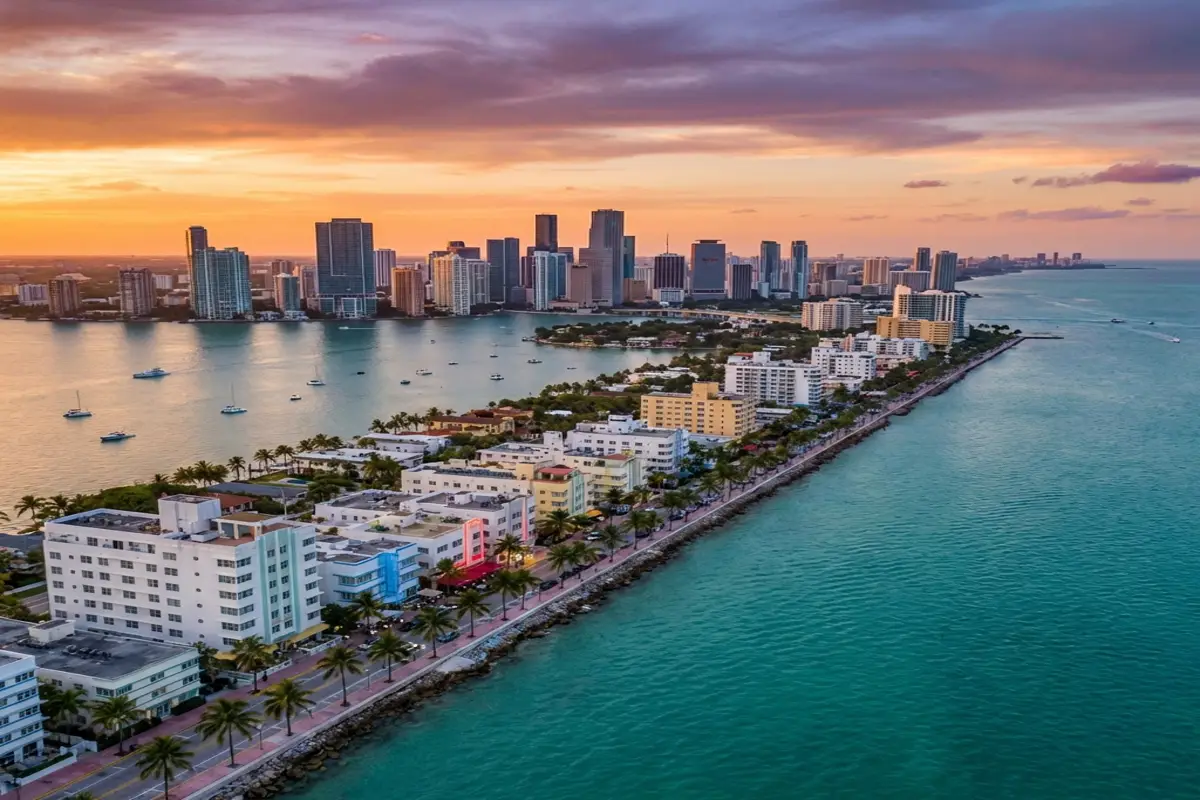
Miami skyline

Miami, FL

Complete city guide with real-time data from official US government sources.

75°
Current
Chance Showers And Thunderstorms
H: 80° L: 63°
455,955
Population
$68,635
Median Income
$600K
Median Home Price
38.6%
Bachelor's Degree+
Purchasing Power Analysis

Lifestyle Impact in Miami

Miami is 11.8% more expensive than the national average. We calculate how much your salary "feels like" here.

Real Purchasing Power
$76,029
-11%
Reduction in lifestyle value
Relative to US Average
COL Adjusted
Real-time Metrics

Miami: The Data Profile (2026)

Miami presents a complex economic paradox for the 2026 relocator. With a population of 455,955, the city operates as a mid-sized urban hub where the median household income sits at $68,635—a significant -8.0% deviation below the US median of $74,580. This income deficit is partially offset by a highly skilled labor pool; 38.6% of residents hold a bachelor's degree or higher, surpassing the national average of 33.1%. The statistical target demographic is the "prestige-seeking" remote worker or entrepreneur who prioritizes lifestyle and networking over raw purchasing power, accepting a 18.5% premium on housing costs in exchange for tax-free income and coastal access.

City Score

Cost of Living Analysis

The cost of living index reveals a bifurcated economy. While general goods remain accessible, with Groceries at 98.9 and Transportation at 101.4, the infrastructure costs are deceptively low. Electricity averages 14.14 cents/kWh, undercutting the US average of 16.0 cents, a critical factor for cooling costs. However, the "Miami Premium" is evident in discretionary spending, with the Restaurants index hitting 105.5.

Table 1: Cost of Living Breakdown (Monthly Budgets)

Category Single Person (Monthly) Family of 4 (Monthly) Index (100 = US Avg)
Housing $1,884 $3,027 118.5
Groceries $420 $1,200 98.9
Transportation $280 $750 101.4
Healthcare $350 $1,050 102.6
Restaurants $320 $800 105.5
Utilities $155 $260 92.0
Total $3,409 $7,087 108.2

Disposable Income Analysis:
Based on the median income of $68,635 (approx. $4,290 monthly after taxes), a single person retains approximately $881 in disposable income after covering the $3,409 monthly budget. This tight margin suggests that the median earner is effectively living paycheck-to-paycheck unless they are dual-income. The $1,884 rent burden consumes 44% of net monthly income, categorizing the city as "severely cost-burdened" for the median earner.

💰 Cost of Living vs US Average

Miami's prices compared to national average (100 = US Average)

Cheaper than US
More expensive

Source: BLS & BEA RPP (2025 Est.)

Housing Market Deep Dive

The housing market is defined by high entry barriers and a stagnating sales velocity. The median home price of $585,000 is +39.3% higher than the national average of $420,000, requiring a down payment of roughly $117,000. The market is currently sluggish, with homes sitting for 52 days on average, indicating a shift in leverage away from sellers.

Table 2: Housing Market Data (Buying vs Renting Analysis)

Metric Miami Value US Average Difference (%)
Median Home Price $585,000 $420,000 +39.3%
Price/SqFt $425 $320 +32.8%
Rent (1BR) $1,884 $1,650 +14.2%
Rent (3BR) $3,027 $2,400 +26.1%
Housing Index 118.5 100.0 +18.5%

Buy vs. Rent Relative Analysis:
Renting is currently the financially prudent move relative to the national curve. While renting a 1BR costs $1,884, the cost to own (mortgage, taxes, insurance) on a median home would exceed $4,200 monthly at current rates. The 52-day market cooldown provides renters with increased negotiation power. However, with rent +14.2% above the US average, the "rent forever" strategy is expensive without the equity upside.

🏠 Real Estate Market

$600K
Median Home Price
$539
Per Sq Ft
108
Days on Market
Source: Redfin 2025 estimates

Economic & Job Market Outlook

Miami's economic stability is heavily reliant on the post-remote work landscape. The 38.6% college-educated workforce fuels a service-based economy heavily weighted toward finance, tech, and tourism. The city has aggressively courted remote workers, but Return-to-Office (RTO) mandates are creating friction. Average commute times have crept up to 28 minutes due to infrastructure strain.

Unemployment sits at 3.6%, which is healthier than the US average of 4.0%, suggesting labor demand remains robust despite wage stagnation. The local industry stability is moderate; while finance is growing, the heavy reliance on tourism and real estate creates vulnerability to interest rate fluctuations. The -8.0% income disparity vs. the national average remains the primary economic headwind, suggesting that local job growth is high-volume but not necessarily high-value.

Salary Wars

See how far your salary goes here vs other cities.

$75,000
US National Average
$75,000
Nominal Value
Real Value in Miami
$67,084
-10.6% Purchasing Power

Purchasing Power Leaderboard

#1
Houston
$74,850
#2
Chicago
$73,099
#3
Phoenix
$71,090
#4
MiamiYou
$67,084
#5
New York
$66,667

💰 Income Comparison

Quality of Life Audit

Miami offers a "High Risk, High Reward" health profile. The aggregate Health Score of 79.6/100 is respectable, masking specific chronic issues. The Diabetes Rate of 15.5% is alarmingly high compared to the US average of 10.9%, likely correlated with lifestyle factors. Conversely, the Air Quality is exceptional, with an AQI of 32 and PM2.5 levels at 7.8 ug/m3, well below the WHO limit of 10.

Table 3: Quality of Life Metrics

Metric City Value US Average Rating
Health Score 79.6/100 75.0/100 Good
Obesity Rate 29.9% 31.9% Average
Diabetes Rate 15.5% 10.9% High
Smoking Rate 12.3% 14.0% Average
AQI (Air Quality) 32 55 Good
PM2.5 (Annual) 7.8 ug/m3 10.5 ug/m3 Good
Unemployment Rate 3.6% 4.0% Average

Safety & Environment:
Safety remains the city's most significant detractor. Violent crime stands at 642/100k (vs. 380/100k US avg), and Property Crime is 3,245/100k (vs. 2,000/100k). Residents must budget for security measures (gated communities, alarm systems).

Schools & Weather:
Public school performance is mixed, with a rating of roughly 4/10 on aggregate platforms, though magnet and private options are strong. Weather is the primary draw: currently 72.0°F with highs of 80°F. The "Mostly Clear" conditions contribute to the high AQI, though hurricane season (June–November) introduces significant insurance and safety variables not reflected in annual averages.

Quality of Life Metrics

Air Quality

EPA Annual Average
Good
31AQI
Air quality is satisfactory.
PM2.5 Concentration7.5 µg/m³

Health Pulse

CDC PLACES Data
79.6
Score
Obesity
29.9%
Low Avg (32%) High
Diabetes
15.5%
Smoking
12.3%
Based on CDC PLACES health census data. Higher score indicates better overall public health outcomes.

Safety Score

FBI Crime Data Estimate
Below Avg
Violent Crime
per 100k people
642.0
US Avg: 363.8
Property Crime
per 100k people
3245
US Avg: 1917
Crime rates are generally higher than the national average.

The Verdict

Pros:

  • Air Quality: Exceptional metrics (AQI 32, PM2.5 7.8) compared to most US metros.
  • Labor Market: Unemployment is low at 3.6%, and the workforce is highly educated (38.6%).
  • Tax Structure: No state income tax effectively boosts net income by 5-7% relative to high-tax states (though offset by lower median wages).
  • Market Cooling: A 52-day DOM suggests the extreme seller's market is softening.

Cons:

  • Income vs. Cost: Median income ($68,635) is -8.0% lower than the US, while housing is +39.3% higher.
  • Safety: Violent crime is 68% higher than the national average.
  • Health Risks: Diabetes rates are 42% higher than the US average.
  • Insurance Costs: While electricity is cheap, property insurance premiums in Miami are among the highest in the nation (not explicitly listed but a critical economic factor).

Final Recommendation:
Miami is NOT recommended for the single-income median earner. The math does not work; the $3,409 monthly cost requires a salary of at least $90,000 to maintain a healthy debt-to-income ratio. It IS recommended for dual-income households earning a combined $120,000+, remote workers leveraging tax advantages, or professionals in finance/tech who can command salaries well above the local median.

FAQs

1. What salary is needed to live comfortably in Miami in 2026?
To cover the $3,409 monthly expenses for a single person and maintain a 20% savings rate, a gross salary of approximately $85,000 is required. For a family of four, a combined income of $150,000 is the baseline for comfort.

2. Is the Value vs. other cities worth the "Miami Premium"?
No, purely on a dollars-to-purchasing power basis. You are paying +39.3% more for housing and +5.5% more for dining to earn -8.0% less than the national median. The value proposition lies entirely in the lifestyle (weather, culture) and tax benefits, not economic efficiency.

3. How do the safety stats compare to other cities?
Poorly. With a Violent Crime rate of 642/100k, Miami is significantly more dangerous than the average US city (380/100k). Property crime is also a major issue at 3,245/100k. Due diligence on neighborhood selection is mandatory.

4. Is now (2026) the best time to buy or rent?
Rent. With the Housing Index at 118.5 and a slow market (52 days on market), prices are likely to stabilize or correct slightly. Renting allows you to test neighborhoods and avoid the high entry costs of a $585,000 median home while the market finds its new equilibrium.

Loading...