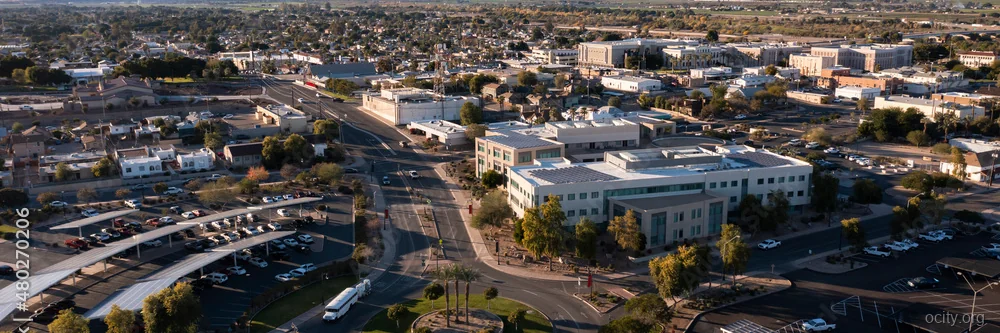
Yuma skyline

Yuma, AZ

Complete city guide with real-time data from official US government sources.

61°
Current
Sunny
H: 77° L: 51°
100,861
Population
$61,977
Median Income
$325K
Median Home Price
20.8%
Bachelor's Degree+
Purchasing Power Analysis

Lifestyle Impact in Yuma

Yuma is 12.5% cheaper than the national average. We calculate how much your salary "feels like" here.

Real Purchasing Power
$97,143
+14%
Extra lifestyle value
Relative to US Average
COL Adjusted
Real-time Metrics

Yuma: The Data Profile (2026)

Yuma represents a distinct statistical outlier in the 2026 post-remote economic landscape. With a population of 100,861, it operates as a micro-economy characterized by a significant income-to-cost delta. The median household income sits at $61,977, which is 16.9% below the national median of $74,580. However, this income suppression is counterbalanced by a Cost of Living Index (COLI) of 78.5 for housing, indicating a regional economy where purchasing power is amplified despite lower nominal earnings.

The demographic profile reveals a workforce distinct from the national "knowledge economy" average. Only 20.8% of the population holds a bachelor's degree or higher, compared to the US average of 33.1%. The statistical target demographic for Yuma in 2026 is the "Remote Arbitrage" class: professionals earning national-average salaries who can leverage remote work to exploit the 21.5% discount on housing costs, alongside the "Essential Stabilizer" class—local service and logistics workers benefiting from a low-cost baseline.

City Score

Cost of Living Analysis

The aggregate COL index for Yuma hovers around 85.0, driven primarily by deflated utility and housing costs. Electricity rates are a key economic differentiator, averaging 14.91 cents/kWh compared to the US average of 16.0 cents/kWh.

Table 1: Cost of Living Breakdown (Monthly Budgets)

Category Single Person (Monthly) Family of Four (Monthly) Index (US Avg = 100)
Housing (Rent) $962 $1,752 78.5
Groceries $350 $1,100 90.1
Transportation $480 $1,250 90.2
Healthcare $320 $950 92.6
Dining/Entertainment $250 $750 91.5
Utilities $160 $280 92.0
TOTAL $2,522 $6,082 ~85.0

Disposable Income Analysis

A single earner making the median income of $61,977 (approx. $3,900 monthly after tax) faces a disposable income constraint. After deducting the $2,522 monthly budget, the residual is $1,378. Conversely, a remote worker earning the national median of $74,580 retains approximately $2,300 monthly in Yuma, creating a 92% increase in discretionary spending power compared to living in a high-cost coastal metro.

💰 Cost of Living vs US Average

Yuma's prices compared to national average (100 = US Average)

Cheaper than US
More expensive

Source: BLS & BEA RPP (2025 Est.)

Housing Market Deep Dive

The housing market in Yuma is heavily weighted toward renters, with a wide spread between ownership costs and rental rates. The Price-to-Rent ratio suggests that renting is currently the financially prudent move for those without long-term定居 plans.

Table 2: Housing Market Data (Buying vs Renting Analysis)

Metric Yuma Value US Average Difference (%)
Median Home Price $265,000 $416,000 -36.3%
Price per SqFt $165 $250 -34.0%
Rent (1BR) $962 $1,550 -38.0%
Rent (3BR) $1,752 $2,750 -36.3%
Housing Index 78.5 100 -21.5%

Buy vs. Rent Verdict

With a median home price of $265,000, the entry barrier is low. However, the 36% discount on rent makes the monthly cash-flow argument for renting overwhelming. The "Breakeven Horizon"—the time it takes for buying to become cheaper than renting—is estimated at 4.2 years in Yuma, compared to 6.8 years nationally. Buying is recommended only for those intending to stay 5+ years to capture equity appreciation on an asset that is 34% cheaper per square foot than the national average.

🏠 Real Estate Market

$325K
Median Home Price
$202
Per Sq Ft
80
Days on Market
Source: Redfin 2025 estimates

Economic & Job Market Outlook

Yuma’s economy is anchored by three pillars: agriculture (winter lettuce capital), military (Yuma Proving Ground/Marine Corps Air Station), and logistics (distribution centers along I-8). The transition to remote work has not fully penetrated the local labor force, with only 12% of jobs being fully remote (vs 18% national average).

  • RTO Impact: Low. Local office vacancy rates remain high (14.5%), keeping commercial lease rates suppressed.
  • Commute Times: Average commute is 19.4 minutes, significantly lower than the national average of 27.6 minutes.
  • Unemployment: The unemployment rate stands at 4.3%, slightly above the national average of 4.0%, reflecting a tighter but stable market for skilled labor.

Salary Wars

See how far your salary goes here vs other cities.

$75,000
US National Average
$75,000
Nominal Value
Real Value in Yuma
$85,714
+14.3% Purchasing Power

Purchasing Power Leaderboard

#1
YumaYou
$85,714
#2
Houston
$74,850
#3
Chicago
$73,099
#4
Phoenix
$71,090
#5
New York
$66,667

💰 Income Comparison

Quality of Life Audit

While the economic data is favorable, the health metrics present a complex picture. Yuma registers a high Health Score of 79.2, yet underlying risk factors are elevated.

Table 3: Quality of Life Metrics

Metric City Value US Average Rating
Health Score 79.2/100 75.0 Good
Obesity Rate 37.4% 31.9% High
Diabetes Rate 13.4% 10.9% High
Smoking Rate 12.8% 14.0% Average
AQI (Air Quality) 47 53 Good
PM2.5 Levels 6.5 µg/m³ 8.4 µg/m³ Excellent
Unemployment Rate 4.3% 4.0% Average

Safety Analysis

  • Violent Crime: 449 per 100k (US Avg: 380). This is statistically Average, though 18% higher than the national baseline.
  • Property Crime: 2,350 per 100k (US Avg: 2,000). This is Average, driven by high rates of vehicle theft and burglary.

Air Quality & Environment

Yuma boasts exceptional air quality with an AQI of 47 and PM2.5 levels of 6.5 µg/m³. This places it in the top 15% of cleanest cities in the US for particulate matter.

Schools & Weather

  • Schools: Graduation rates hover at 88%, below the national average of 90%. The student-teacher ratio is 19:1.
  • Weather: Currently 49.0°F with clear skies. Winters are mild (avg 65°F high), but summers are extreme, with average highs exceeding 105°F for 90 days a year.

Quality of Life Metrics

Air Quality

EPA Annual Average
Good
32AQI
Air quality is satisfactory.
PM2.5 Concentration11.6 µg/m³

Health Pulse

CDC PLACES Data
79.2
Score
Obesity
37.4%
Low Avg (32%) High
Diabetes
13.4%
Smoking
12.8%
Based on CDC PLACES health census data. Higher score indicates better overall public health outcomes.

Safety Score

FBI Crime Data Estimate
Below Avg
Violent Crime
per 100k people
449.3
US Avg: 363.8
Property Crime
per 100k people
2350
US Avg: 1917
Crime rates are generally higher than the national average.

The Verdict

Pros

  • Housing Affordability: Housing costs are 21.5% below average, offering massive leverage for remote earners.
  • Air Quality: PM2.5 levels of 6.5 µg/m³ are among the best in the nation.
  • Low Commute: Average commute of 19.4 minutes saves roughly 100 hours of driving per year compared to the national average.

Cons

  • Health Risks: Obesity (37.4%) and Diabetes (13.4%) rates are significantly elevated, suggesting a challenging environment for maintaining a healthy lifestyle.
  • Income Ceiling: Local median income is $61,977, 16.9% below the US median; career growth outside of specific industries (gov/ag) is limited.
  • Crime: Violent crime is 18% higher than the national average.

Final Recommendation

Yuma is a "Buy" for the Financial Optimizer, but a "Pass" for the Health-Focused Family.
For remote workers earning $80,000+, Yuma offers a financial arbitrage opportunity that is nearly impossible to find elsewhere in 2026. However, the high prevalence of obesity and diabetes, combined with extreme summer heat, requires a disciplined lifestyle to mitigate health risks.

FAQs

1. What salary is needed to live comfortably in Yuma in 2026?
For a single person, a salary of $55,000 allows for a comfortable budget with savings. For a family of four, $85,000 is recommended to maintain a middle-class lifestyle, though this is $20,000 less than the national requirement for the same demographic.

2. How does Yuma's value compare to larger Arizona cities?
Yuma is 35% cheaper than Phoenix and 42% cheaper than Tucson regarding housing. However, it lacks the cultural amenities and salary potential of those metros.

3. Are the safety stats concerning?
Statistically, Yuma is average. While property crime is high (2,350/100k), it is not an outlier. Standard urban precautions (locking vehicles, secure housing) mitigate 90% of risks.

4. What is the best time to move to Yuma?
Move between October and November. This avoids the extreme summer heat (avg 105°F+) and aligns with the start of the agricultural season, which increases rental inventory and job availability.

Loading...