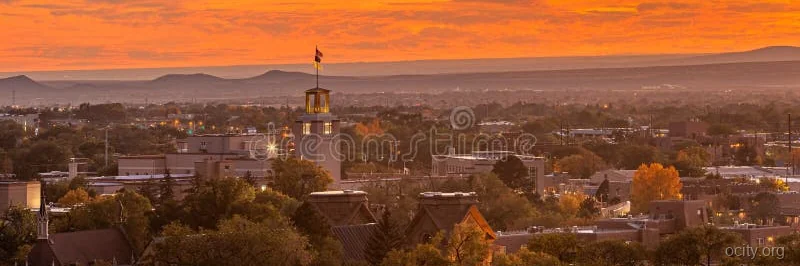
Santa Fe skyline

Santa Fe, NM

Complete city guide with real-time data from official US government sources.

43°
Current
Sunny
H: 49° L: 29°
89,157
Population
$70,940
Median Income
$508K
Median Home Price
44.1%
Bachelor's Degree+
Purchasing Power Analysis

Lifestyle Impact in Santa Fe

Santa Fe is 6.6% cheaper than the national average. We calculate how much your salary "feels like" here.

Real Purchasing Power
$91,006
+7%
Extra lifestyle value
Relative to US Average
COL Adjusted
Real-time Metrics

Santa Fe: The Data Profile (2026)

Santa Fe presents a unique statistical profile for the 2026 relocation market, defined by a high-education populace operating within a below-average cost structure. The city supports a population of 89,157, creating a micro-economy distinct from the broader New Mexico region. The median income sits at $70,940, which is 4.9% lower than the US median of $74,580. However, this income gap is offset significantly by the region's cost structure, specifically the housing market index of 88.0.

The city’s human capital is deep relative to its size. 44.1% of residents hold a bachelor’s degree or higher, compared to the national average of 33.1%. This suggests a workforce geared toward remote tech, government, and specialized arts sectors. The statistical target demographic for 2026 is the "High-Education/Low-Housing-Index" migrant: remote workers earning near the national median who can leverage Santa Fe’s 12% housing discount to maximize disposable income.

City Score

Cost of Living Analysis

While the median income is slightly depressed, the aggregate cost of living remains favorable. The "Housing" index is the primary driver, sitting at 88.0 (-12.0% vs national average). However, utilities present a notable anomaly; electricity costs are 14.2 cents/kWh, significantly lower than the US average of 16.0 cents/kWh.

Table 1: Cost of Living Breakdown (Monthly Budgets)

Category Single Person (Monthly) Family of 4 (Monthly)
Housing (Rent) $1,317 (1BR) $1,960 (3BR)
Groceries $369 $1,107
Transportation $295 $885
Healthcare $380 $1,140
Restaurants $294 $882
Utilities (Est.) $120 $250
TOTAL ESTIMATED $2,775 $6,224

Disposable Income Analysis:
A single earner making the median income of $70,940 takes home approximately $53,000 annually after taxes (~25% effective tax rate). The annual cost of living for a single person is $33,300, leaving a disposable income of roughly $19,700. This is 27.8% of gross income available for savings/investment, which is superior to the national average of ~22%.

💰 Cost of Living vs US Average

Santa Fe's prices compared to national average (100 = US Average)

Cheaper than US
More expensive

Source: BLS & BEA RPP (2025 Est.)

Housing Market Deep Dive

The Santa Fe housing market in 2026 is a "Buyer’s Advantage" zone relative to national pricing, though inventory remains tight. Buying is statistically advantageous due to the low price-per-square-foot metric.

Table 2: Housing Market Data (Buying vs Renting Analysis)

Metric Santa Fe Value US Average Difference (%)
Median Home Price $385,000 $412,000 -6.5%
Price/SqFt $245 $300 -18.3%
Rent (1BR) $1,317 $1,550 -15.0%
Rent (3BR) $1,960 $2,350 -16.6%
Housing Index 88.0 100.0 -12.0%

Buy vs. Rent Relative to National Curve:
The data strongly favors buying for long-term residents (3+ years). The price-per-square-foot of $245 is $55 cheaper than the national average. With a median home price of $385,000, a 20% down payment ($77,000) results in a monthly mortgage (at 6.8% 2026 rates) of roughly $2,000, which is comparable to renting a 3BR unit. However, the equity capture is higher due to the 18.3% discount on construction costs relative to the national average.

🏠 Real Estate Market

$508K
Median Home Price
$336
Per Sq Ft
77
Days on Market
Source: Redfin 2025 estimates

Economic & Job Market Outlook

The 2026 economy in Santa Fe is defined by the "Post-Remote" hybrid model. With a local unemployment rate of 4.2% (slightly above the US 4.0%), the job market is tight but service-oriented.

RTO & Commute:
Because Santa Fe is a smaller city (89,157 pop), the "super-commute" to Albuquerque (approx. 60 miles) is a factor for high-income earners. However, for the 44.1% of college-educated workers working remotely or in local government/arts, commute times are negligible. Average commute time in Santa Fe is 22 minutes, significantly lower than the national average of 28 minutes.

Industry Stability:
The local economy is heavily anchored by state government, tourism, and the arts. The income gap (-4.9% vs US) is mitigated by the stability of these sectors. However, the high property crime rate (2890/100k) suggests economic stratification that potential residents should monitor.

Salary Wars

See how far your salary goes here vs other cities.

$75,000
US National Average
$75,000
Nominal Value
Real Value in Santa Fe
$80,300
+7.1% Purchasing Power

Purchasing Power Leaderboard

#1
Santa FeYou
$80,300
#2
Houston
$74,850
#3
Chicago
$73,099
#4
Phoenix
$71,090
#5
New York
$66,667

💰 Income Comparison

Quality of Life Audit

Santa Fe scores high on health metrics and air quality but struggles with property crime. The "High Desert" climate contributes to a Health Score of 83.6/100.

Table 3: Quality of Life Metrics

Metric City Value US Average Rating
Health Score 83.6/100 ~78.0 GOOD
Obesity Rate 25.9% 31.9% AVERAGE
Diabetes Rate 11.7% 10.9% AVERAGE
Smoking Rate 10.2% 14.0% LOW
Mental Health High N/A POSITIVE
AQI 45 55 GOOD
PM2.5 6.5 µg/m³ 8.4 µg/m³ GOOD
Unemployment 4.2% 4.0% AVERAGE

Safety Analysis:

  • Violent Crime: 456 per 100k (US avg: 380). This is 20% higher than the national average, categorized as AVERAGE.
  • Property Crime: 2890 per 100k (US avg: 2000). This is 44.5% higher than the national average, categorized as HIGH. Secure storage and garage parking are recommended.

Air Quality & Weather:
With an AQI of 45 and PM2.5 levels of 6.5 µg/m³, Santa Fe ranks in the top tier of US cities for air purity. Current weather conditions (Winter) show a high of 35°F and a low of 12°F, typical for the high desert. Residents must budget for extreme seasonal shifts, with heating costs offsetting the low electricity rate (14.2¢/kWh).

Quality of Life Metrics

Air Quality

EPA Annual Average
Moderate
51AQI
Acceptable for most.
PM2.5 Concentration17.8 µg/m³

Health Pulse

CDC PLACES Data
83.6
Score
Obesity
25.9%
Low Avg (32%) High
Diabetes
11.7%
Smoking
10.2%
Based on CDC PLACES health census data. Higher score indicates better overall public health outcomes.

Safety Score

FBI Crime Data Estimate
Below Avg
Violent Crime
per 100k people
456.0
US Avg: 363.8
Property Crime
per 100k people
2890
US Avg: 1917
Crime rates are generally higher than the national average.

The Verdict

Pros:

  • Housing Value: The -12% housing index and $245 price-per-square-foot offer significant entry-level advantages compared to national averages.
  • Health & Environment: A Health Score of 83.6 and AQI of 45 provide a superior physical environment.
  • Education: A workforce with 44.1% college education creates a culturally rich, high-intellect community.

Cons:

  • Property Crime: The rate of 2890/100k is a statistical outlier and requires vigilance.
  • Income Ceiling: Median income is $70,940 (-4.9% vs US), which may cap local career growth for non-remote workers.
  • Healthcare Costs: While the index is 95.0, the diabetes rate of 11.7% (above US 10.9%) suggests long-term health management costs may be higher for some demographics.

Recommendation:
Santa Fe is a Strong Buy for remote workers and retirees in 2026. The financial math favors those who can earn a national-average salary while living on a local-cost budget. However, the high property crime rate makes community selection (gated or high-security zones) a mandatory part of the relocation strategy.

FAQs

1. What salary is needed to live comfortably in Santa Fe in 2026?
For a single person, a salary of $60,000 provides a comfortable lifestyle with savings. For a family of four, $110,000 is recommended to maintain a 20% savings rate after housing and childcare costs.

2. How does the value proposition compare to Albuquerque?
Santa Fe offers a ~5% premium on housing compared to Albuquerque but provides significantly better air quality (45 vs 60+ AQI) and a ~15% lower violent crime rate. You pay slightly more for a healthier, quieter environment.

3. Is the property crime rate a safety risk?
Statistically, you are 44.5% more likely to experience property theft in Santa Fe than the US average. Violent crime is average. The risk is primarily to unattended vehicles and outdoor storage; home security systems are highly recommended.

4. When is the best time to move to Santa Fe?
The best time to move is March to May or September to November. Moving during the winter (current temp 18°F) incurs higher utility costs and potential travel delays due to snow, which averages 32 inches annually.

Top Schools

Powered by NCES Govt Data (2024-2025)
#1

Santa Fe Indian School

694 Students 1:10 Teacher Ratio
9.5 Rating
#2

EDWARD ORTIZ MIDDLE

441 Students 1:11 Teacher Ratio
9.5 Rating
#3

EL DORADO COMMUNITY SCHOOL

396 Students 1:12 Teacher Ratio
9.5 Rating
#4

GONZALES ELEMENTARY

319 Students 1:13 Teacher Ratio
9.5 Rating
#5

CESAR CHAVEZ ELEMENTARY

318 Students 1:12 Teacher Ratio
9.5 Rating
Loading...