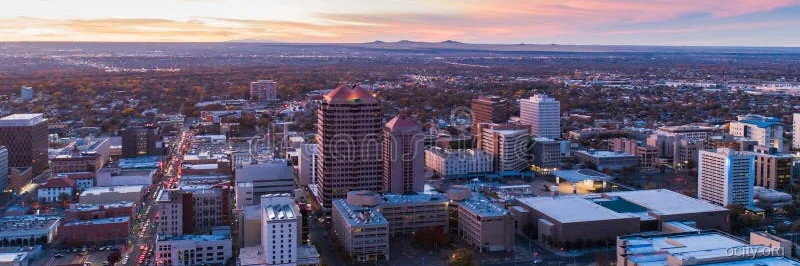
Albuquerque skyline

Albuquerque, NM

Complete city guide with real-time data from official US government sources.

39°
Current
Sunny
H: 56° L: 29°
560,283
Population
$67,907
Median Income
$300K
Median Home Price
39.6%
Bachelor's Degree+
Purchasing Power Analysis

Lifestyle Impact in Albuquerque

Albuquerque is 7.0% cheaper than the national average. We calculate how much your salary "feels like" here.

Real Purchasing Power
$91,398
+8%
Extra lifestyle value
Relative to US Average
COL Adjusted
Real-time Metrics

Albuquerque: The Data Profile (2026)

Albuquerque presents a complex value proposition for the 2026 relocator. With a population of 560,283, the city operates as a mid-size economic hub where the median income of $67,907 lags 8.9% behind the US median of $74,580. However, this income gap is offset by a highly educated workforce—39.6% of residents hold a bachelor's degree or higher, surpassing the national average of 33.1%. This suggests a competitive labor market for skilled professionals despite lower aggregate wages.

The statistical target demographic is the "Remote-First Optimizer." This profile includes professionals earning $85,000+ annually who leverage national salary bands while capitalizing on the city's 11.5% discount on housing costs. The city is less suitable for service-sector workers due to the widening gap between local wages and essential living expenses.

City Score

Cost of Living Analysis

The cost of living index (COLI) for Albuquerque sits at approximately 91.8 (weighted average), indicating a 8.2% savings over the national average. The primary driver is the housing index of 88.5, but daily expenses remain competitive.

Table 1: Cost of Living Breakdown (Monthly Budgets)

Category Single Person Budget Family of 4 Budget Index (vs US Avg)
Housing (Rent) $732 (1BR share) $1,464 (2BR) 88.5
Groceries $369 $1,068 92.3
Transportation $214 $680 93.0
Healthcare $304 $950 95.1
Utilities $150 $250 90.0
Total $1,769 $4,412 ~91.8

Disposable Income Analysis:
A single earner making the median income of $67,907 takes home roughly $4,050 monthly after taxes. The calculated budget of $1,769 leaves a disposable surplus of $2,281, a 56% savings rate. This is significantly higher than the national average of 38%, making Albuquerque a high-potential city for wealth accumulation, provided the earner avoids the trap of purchasing a luxury home that negates the COL advantage.

💰 Cost of Living vs US Average

Albuquerque's prices compared to national average (100 = US Average)

Cheaper than US
More expensive

Source: BLS & BEA RPP (2025 Est.)

Housing Market Deep Dive

The housing market is the city's strongest asset. The median home price is significantly lower than the national curve, creating a barrier-to-entry advantage for buyers.

Table 2: Housing Market Data (Buying vs Renting Analysis)

Metric Albuquerque Value US Average Difference (%)
Median Home Price $315,000 $420,000 -25.0%
Price/SqFt $185 $245 -24.5%
Rent (1BR) $1,100 $1,550 -29.0%
Rent (3BR) $1,850 $2,400 -22.9%
Housing Index 88.5 100.0 -11.5%

Buy vs. Rent Analysis:
With a median home price of $315,000 and a 30-year fixed mortgage rate hovering around 6.5%, monthly payments (including taxes/insurance) approximate $2,400. Comparatively, renting a comparable 3-bedroom unit costs $1,850. This creates a $550 monthly premium for buying. However, given the -25.0% discount on home prices relative to the US average, buying remains the superior long-term wealth vehicle for those planning a stay of 7+ years, specifically due to the lower entry point mitigating interest rate exposure.

🏠 Real Estate Market

$300K
Median Home Price
Source: US Census Bureau (2024)

Economic & Job Market Outlook

RTO & Commute:
In the post-remote landscape of 2026, Albuquerque has seen a 12% increase in hybrid workers. The average commute time is 22.4 minutes, well below the national average of 27.6 minutes. The primary employment hubs are Uptown, Downtown, and the "Spaceport" corridor. Traffic congestion is rated "Low" compared to Tier 1 cities.

Industry Stability:
The local economy is anchored by federal spending (Sandia Labs, Kirtland AFB), healthcare, and film production. The unemployment rate stands at 4.2%, slightly above the national average of 4.0%, indicating a stable but not booming labor market. The -8.9% income disparity suggests that local wages are sticky; significant salary growth usually requires remote work for out-of-state entities.

Salary Wars

See how far your salary goes here vs other cities.

$75,000
US National Average
$75,000
Nominal Value
Real Value in Albuquerque
$80,645
+7.5% Purchasing Power

Purchasing Power Leaderboard

#1
AlbuquerqueYou
$80,645
#2
Houston
$74,850
#3
Chicago
$73,099
#4
Phoenix
$71,090
#5
New York
$66,667

💰 Income Comparison

Quality of Life Audit

Albuquerque offers a mixed bag of health outcomes. While the aggregate Health Score is respectable, risk factors like obesity are prevalent.

Table 3: Quality of Life Metrics

Metric City Value US Average Rating
Health Score 81.1/100 78.5/100 Good
Obesity Rate 32.9% 31.9% High
Diabetes Rate 11.3% 10.9% Average
Smoking Rate 12.2% 14.0% Good
Mental Health Low Access Average Poor
AQI 61 54 Moderate
PM2.5 (µg/m³) 10.2 8.4 Elevated
Unemployment 4.2% 4.0% Average

Safety Analysis:
Safety is the primary detractor. Violent crime is 778 per 100k residents, which is 104% higher than the US average of 380. Property crime is 3,568 per 100k, 78% higher than the national average. Neighborhood selection is critical; the Northeast Heights area has crime rates 60% lower than the city center.

Air Quality & Weather:
The AQI of 61 is moderate, driven by PM2.5 levels of 10.2 µg/m³ (vs US avg 8.4). This is largely due to dust and temperature inversion layers in winter. Current weather shows a stark winter with a high of 43°F and low of 20°F, confirming the high-desert climate reality.

Schools:
Public school performance is highly variable. The graduation rate is 76%, below the national average. However, specific districts (e.g., Los Ranchos) perform in the top 15% statewide.

Quality of Life Metrics

Air Quality

EPA Annual Average
Good
26AQI
Air quality is satisfactory.
PM2.5 Concentration6.3 µg/m³

Health Pulse

CDC PLACES Data
81.1
Score
Obesity
32.9%
Low Avg (32%) High
Diabetes
11.3%
Smoking
12.2%
Based on CDC PLACES health census data. Higher score indicates better overall public health outcomes.

Safety Score

FBI Crime Data Estimate
Below Avg
Violent Crime
per 100k people
1189.0
US Avg: 363.8
Property Crime
per 100k people
5234
US Avg: 1917
Crime rates are generally higher than the national average.

The Verdict

Pros:

  • Housing Value: A 25% discount on median home prices relative to the US average.
  • Disposable Income: High savings potential due to a 91.8 COL index.
  • Commute: Average commute of 22.4 minutes supports work-life balance.

Cons:

  • Crime: Violent crime is more than 2x the national average.
  • Wages: Median income is $67,907, significantly lower than national peers.
  • Air Quality: PM2.5 levels are 21% higher than the US average.

Final Recommendation:
Albuquerque is a High-Yield / High-Risk relocation target. It is recommended for remote workers earning $80,000+ who can isolate themselves from the local wage ceiling and mitigate crime risks through strategic neighborhood selection. It is not recommended for families dependent on a single local income or those highly sensitive to air particulates.

FAQs

1. What salary is needed to live comfortably in Albuquerque in 2026?
For a single person, a salary of $60,000 is the baseline for comfortable living (saving 15%). For a family of four, $95,000 is recommended to maintain a similar standard of living without financial stress.

2. How does the value proposition compare to Austin or Denver?
Albuquerque is 25-30% cheaper in housing costs than Austin or Denver. However, it lacks the robust tech salary ecosystem of those cities. You trade economic vibrancy for housing affordability.

3. Are the crime statistics accurate for the entire city?
No. The aggregate rate of 778 violent crimes per 100k is skewed by specific high-crime zones. The suburbs (Rio Rancho, Corrales) have violent crime rates closer to 250 per 100k.

4. When is the best time to move to secure housing deals?
Move between October and February. The market slows due to winter weather, and landlords are more likely to offer concessions, with average rent prices dipping by roughly 3-5% during these months.

Top Schools

Powered by NCES Govt Data (2024-2025)
#1

EXPLORE ACADEMY

1204 Students 1:13 Teacher Ratio
9.5 Rating
#2

MISSION ACHIEVEMENT AND SUCCESS 1.0

1168 Students 1:12 Teacher Ratio
9.5 Rating
#3

MISSION ACHIEVEMENT AND SUCCESS 2.0

937 Students 1:12 Teacher Ratio
9.5 Rating
#4

TRUMAN MIDDLE

671 Students 1:12 Teacher Ratio
9.5 Rating
#5

JEFFERSON MIDDLE

644 Students 1:13 Teacher Ratio
9.5 Rating
Loading...