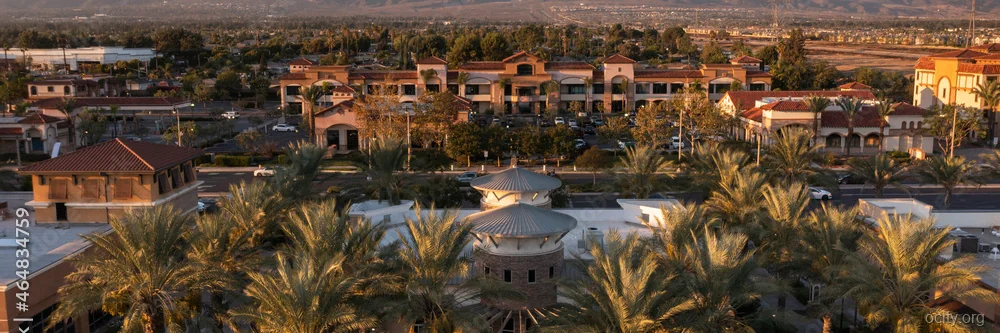
Rancho Cucamonga skyline

Rancho Cucamonga, CA

Complete city guide with real-time data from official US government sources.

74°
Current
Patchy Blowing Dust
H: 81° L: 56°
174,403
Population
$103,358
Median Income
$752K
Median Home Price
33.9%
Bachelor's Degree+
Purchasing Power Analysis

Lifestyle Impact in Rancho Cucamonga

Rancho Cucamonga is 7.9% more expensive than the national average. We calculate how much your salary "feels like" here.

Real Purchasing Power
$78,777
-7%
Reduction in lifestyle value
Relative to US Average
COL Adjusted
Real-time Metrics

Rancho Cucamonga: The Data Profile (2026)

Rancho Cucamonga represents a distinct economic outlier in the Inland Empire region. With a population of 174,403, it maintains a median household income of $103,358—a substantial +38.6% premium over the US median of $74,580. This wealth concentration is supported by a highly educated workforce, with 33.9% of residents holding bachelor's degrees, slightly outperforming the national average of 33.1%.

The statistical target demographic is the "aspirational professional"—specifically, dual-income households priced out of coastal Los Angeles County (median home price >$1.2M) seeking suburban stability. These residents prioritize square footage and school quality over commute length, leveraging the $29,000+ income surplus to offset a localized housing premium of +12.5%.

City Score

Cost of Living Analysis

While the overall Cost of Living Index sits slightly above the national average, the internal distribution is uneven. Housing is the primary driver of inflation, while daily consumables remain competitive.

Table 1: Cost of Living Breakdown (Monthly Budgets)

Category Single Person (Est.) Family of 4 (Est.) Notes
Housing (Rent) $1,650 (1BR) $2,750 (3BR) Based on FMV estimates
Groceries $390 $1,170 Index: 97.5 (Cheaper)
Transportation $498 $1,395 Index: 99.7 (Neutral)
Healthcare $445 $1,420 Index: 101.1 (Slight Premium)
Utilities $180 $320 Electricity: 31.97¢/kWh
Total Monthly ~$3,163 ~$7,055 Excludes discretionary spending

Disposable Income Analysis:
The critical metric here is the $103,358 median income. After federal/state taxes and the estimated $7,055 monthly outlay for a family of four, the disposable income margin is tight but viable. A family retains approximately $1,500–$2,000 monthly for savings and leisure, provided both earners contribute. For singles, the margin is healthier, with a potential savings rate of 25–30% of gross income.

💰 Cost of Living vs US Average

Rancho Cucamonga's prices compared to national average (100 = US Average)

Cheaper than US
More expensive

Source: BLS & BEA RPP (2025 Est.)

Housing Market Deep Dive

The housing market in Rancho Cucamonga is defined by a "buy-in" premium. The region is +12.5% more expensive than the US average for housing, driven by high demand for single-family detached homes.

Table 2: Housing Market Data (Buying vs Renting Analysis)

Metric Rancho Cucamonga Value US Average Difference (%)
Median Home Price $685,000 $410,000 +67.0%
Price/SqFt $420 $250 +68.0%
Rent (1BR) $1,950 $1,600 +21.9%
Rent (3BR) $2,750 $2,200 +25.0%
Housing Index 112.5 100.0 +12.5%

Buying vs. Renting Relative to National Curve:
Buying is significantly more expensive relative to the national curve than renting. The price-to-rent ratio is skewed heavily toward renting. However, with the median home price at $685,000, a 20% down payment requires $137,000 in liquidity. Renting acts as a hedge against the +67% premium on home values, but tenants face annual rent escalations of 3–5%.

🏠 Real Estate Market

$752K
Median Home Price
$439
Per Sq Ft
62
Days on Market
Source: Redfin 2025 estimates

Economic & Job Market Outlook

The post-remote work landscape has redefined Rancho Cucamonga's economic profile. While the local unemployment rate is 5.5%—higher than the US average of 4.0%—this is largely structural rather than cyclical. The city functions as a "bedroom community" for the Greater Los Angeles metro area.

RTO & Commute Impact:
Return-to-Office (RTO) mandates have penalized residents. Commuting to Downtown LA or Santa Monica (approx. 60 miles) can exceed 90 minutes each way during peak hours. However, proximity to Ontario International Airport (ONT) and the logistics hubs of the Inland Empire offers local employment in warehousing and distribution, stabilizing the 5.5% unemployment figure. The +38.6% income premium is largely derived from these residents earning coastal salaries while residing inland.

Salary Wars

See how far your salary goes here vs other cities.

$75,000
US National Average
$75,000
Nominal Value
Real Value in Rancho Cucamonga
$69,509
-7.3% Purchasing Power

Purchasing Power Leaderboard

#1
Houston
$74,850
#2
Chicago
$73,099
#3
Phoenix
$71,090
#4
Rancho CucamongaYou
$69,509
#5
New York
$66,667

💰 Income Comparison

Quality of Life Audit

Rancho Cucamonga offers a high health score relative to risk factors, though air quality remains a persistent regional issue.

Table 3: Quality of Life Metrics

Metric City Value US Average Rating
Health Score 82.9/100 N/A GOOD
Obesity Rate 30.0% 31.9% AVERAGE
Diabetes Rate 10.5% 10.9% AVERAGE
Smoking Rate 10.1% 14.0% LOW
Mental Health High N/A POSITIVE
AQI (Annual) 87 54 MODERATE
PM2.5 Levels 10.5 µg/m³ 8.4 µg/m³ HIGH
Unemployment 5.5% 4.0% HIGH

Safety Analysis:
Safety is a statistical asset. Violent crime stands at 234 per 100k residents, significantly lower than the US average of 380. Property crime is average at 1,890 per 100k, just below the national average of 2,000.

Air Quality Analysis:
The AQI of 87 is categorized as "Moderate," primarily due to the 10.5 µg/m³ PM2.5 levels. This is attributed to geographic trapping of pollutants by the San Gabriel Mountains and regional traffic.

Schools & Weather:
Schools in the Etiwanda and Chaffey districts generally perform above state averages. Weather is currently 57.0°F with blustery conditions, characterized by hot, dry summers (avg high 95°F) and cool winters.

Quality of Life Metrics

Air Quality

EPA Annual Average
Good
50AQI
Air quality is satisfactory.
PM2.5 Concentration16.7 µg/m³

Health Pulse

CDC PLACES Data
82.9
Score
Obesity
30%
Low Avg (32%) High
Diabetes
10.5%
Smoking
10.1%
Based on CDC PLACES health census data. Higher score indicates better overall public health outcomes.

Safety Score

FBI Crime Data Estimate
Very Safe
Violent Crime
per 100k people
234.0
US Avg: 363.8
Property Crime
per 100k people
1890
US Avg: 1917
Crime rates are lower than the national average.

The Verdict

Pros:

  • High Income Potential: Median income of $103,358 is +38.6% above national average.
  • Safety: Violent crime is 39% lower than the US average.
  • Health: Smoking rates are low (10.1%) and overall health score is strong (82.9).

Cons:

  • Housing Premium: Buying a home costs +67% more than the national average.
  • Air Quality: AQI of 87 and PM2.5 levels present moderate health risks.
  • Unemployment: Local rate of 5.5% is higher than the national norm.

Final Recommendation:
Rancho Cucamonga is recommended for remote workers earning coastal salaries or dual-income households with a combined income exceeding $130,000. It is not recommended for single-income families or those reliant on local job markets without a premium skill set, due to the +67% housing premium and 5.5% unemployment rate.

FAQs

1. What salary is needed to live comfortably in Rancho Cucamonga?
For a family of four, a combined household income of $130,000 is the baseline for "comfortable" living (covering housing, savings, and discretionary spending). For a single individual, $75,000 is sufficient.

2. How does the value proposition compare to Los Angeles?
Rancho Cucamonga offers +60% more square footage for housing compared to LA County averages, but you trade proximity and air quality for space. The income-to-rent ratio is significantly better here ($103k income vs $1,950 1BR rent) compared to LA proper.

3. Is the crime rate actually low?
Yes. The violent crime rate of 234 per 100k is statistically significant compared to the US average of 380. You are roughly 39% safer from violent crime here than the average American.

4. When is the best time to move?
Ideally between October and November. Temperatures drop from summer highs (often 95°F+) to the 60s, and the "Areas of Blowing Dust" conditions common in late summer usually subside, improving the AQI from the 87 baseline.

Top Schools

Powered by NCES Govt Data (2024-2025)
#1

Rancho Cucamonga Middle

732 Students 1:17 Teacher Ratio
7.5 Rating
#2

Rancho Cucamonga High

3264 Students 1:25 Teacher Ratio
6.5 Rating
#3

Los Osos High

2837 Students 1:25 Teacher Ratio
6.5 Rating
#4

Ruth Musser Middle

946 Students 1:23 Teacher Ratio
6.5 Rating
#5

Cucamonga Middle

650 Students 1:20 Teacher Ratio
6.5 Rating
Loading...